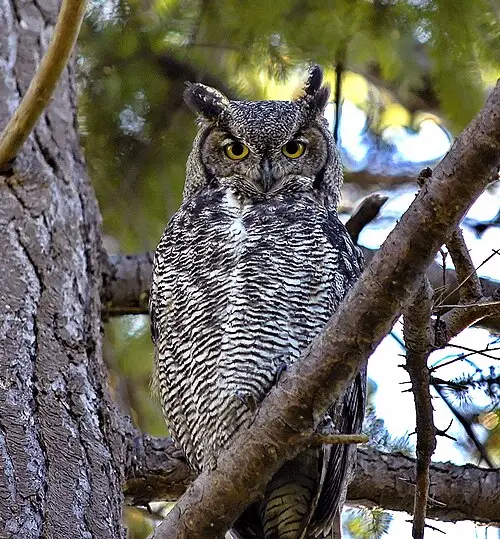
 📸 Photo
Photo: brendan.lally · CC BY 2.0 · Wikimedia Commons Source
Great Horned Owl
Bubo virginianus (Great Horned Owl · アメリカワシミミズク)
💡 Everyday Comparisons for Size, Mass & Speed
- 💡 Its wingspan of 1.52 m is similar to an adult's arm span, and the average female mass of 1.7 kg is lighter than one 2 L bottle of water (Comparison).
- 💡 Living even around cities and towns, it helps control populations of rodents and insects that people regard as pests (ADW, 'Economic Importance for Humans: Positive').
- 💡 Because it resembles the Eurasian eagle-owl—a Natural Monument (Korea)—it is called the 'New World version of the Eurasian eagle-owl' (ADW, Eurasian eagle-owl account).
Reference standards: coach bus ~12 m, mid-size car ~4.9 m, compact car ~1 t, basketball hoop 3.05 m, credit card 8.56 cm.
Site-computed relative index from recorded values; not a formal scientific metric.
📖 1. Overview
The great horned owl is a large owl widely distributed across the Americas that adapts well to many environments. Its horn-like feather tufts on the head stand out, and it is called the New World version of the Eurasian eagle-owl.
🦴 2. Anatomy & Morphology
It has horn-like feather tufts on top of its head, a distinct white spot on the throat, and brown and black horizontal bars on a white belly. Its forward-facing eyes provide binocular vision, and body size varies by region and sex.
🔍 3. Ecology & Behavior
It is a carnivore that eats a wide variety of available prey such as rabbits, voles, mice, and insects, and near water it also catches fish, amphibians, crustaceans, and reptiles. It perches to watch for prey before swooping down, uses nests abandoned by squirrels or other birds, and usually stays in one area.
🇰🇷 4. Connection to Korea
No direct record connecting this species to Korea has been found.
📚 Sources & References
- • IUCN Red List LC (2018) — https://www.iucnredlist.org/species/61752071/132039486
- • IUCN Red List category LC — latest assessment at iucnredlist.org
- • doi.org — avilist.v2026
- • iucnredlist.org — 132039486
- • wikidata.org — Q81515
- • commons.wikimedia.org — File:Bubo virginianus -Canada-6.jpg
- • animaldiversity.org — Bubo virginianus
- • animaldiversity.org — Bubo bubo
- • Silhouette: PhyloPic — Margot Michaud · CC0 1.0 (Congeneric silhouette — Bubo blakistoni)
Recorded dimensions are widely cited representative estimates from public literature and may vary by study or specimen.