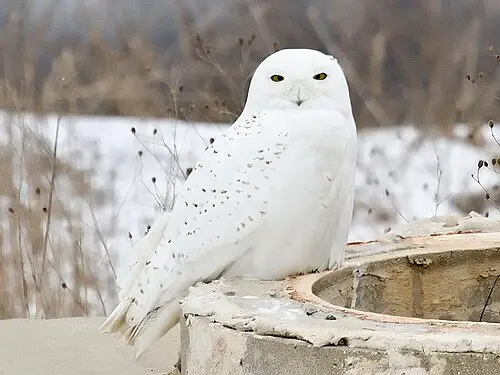
 📸 Photo
Photo: Bill Bouton from San Luis Obispo, CA, USA · CC BY-SA 2.0 · Wikimedia Commons Source
Snowy Owl
Bubo scandiacus (Snowy Owl · シロフクロウ)
💡 Everyday Comparisons for Size, Mass & Speed
- 💡 Its wingspan of 1.7 m is about the height of an adult, and its maximum mass of 1.6 kg is slightly heavier than one 1.5 L bottle of water (Comparison).
- 💡 Because a single owl may eat over 1,600 lemmings in 1 year, it helps regulate rodent populations (ADW, food habits and 'Economic Importance for Humans: Positive').
- 💡 In the Arctic region, it is also known to steal prey from traps set by fur trappers (ADW).
Reference standards: coach bus ~12 m, mid-size car ~4.9 m, compact car ~1 t, basketball hoop 3.05 m, credit card 8.56 cm.
Site-computed relative index from recorded values; not a formal scientific metric.
📖 1. Overview
The snowy owl is a large owl living on open Arctic tundra, and in winter it is also seen near southern towns and cities, wetlands, and sand dunes. On the IUCN Red List, it is assessed as Vulnerable (VU, 2021 assessment).
🦴 2. Anatomy & Morphology
Its body length is 63–73 cm and its wingspan averages 170 cm. Males weigh 1,450–1,500 g and females weigh 1,550–1,600 g, making females slightly heavier.
🔍 3. Ecology & Behavior
It hunts from high perches with a wide view, feeding mainly on lemmings and mice while also taking rabbits, seabirds, and fish when opportunities arise. A single bird may eat more than 1,600 lemmings in 1 year, and depending on food supply it lays 3–11 eggs (up to 16) per clutch.
🇰🇷 4. Connection to Korea
It is listed on the National List of Species of Korea under the Korean name Huin-olppaemi (Korean name).
📚 Sources & References
- • IUCN Red List VU (2021) — https://www.iucnredlist.org/species/22689055/205475036
- • IUCN Red List category VU — latest assessment at iucnredlist.org
- • doi.org — avilist.v2026
- • iucnredlist.org — 205475036
- • 국가생물종목록(국립생물자원관) ktsn 120000528916 — https://species.nibr.go.kr/home/mainHome.do?cont_link=009&subMenu=009002&contCd=009002&ktsn=120000528916
- • wikidata.org — Q170177
- • commons.wikimedia.org — File:Bubo scandiacus male Muskegon.jpg
- • animaldiversity.org — Nyctea scandiaca
- • Silhouette: PhyloPic — Steven Traver · CC0 1.0
Recorded dimensions are widely cited representative estimates from public literature and may vary by study or specimen.