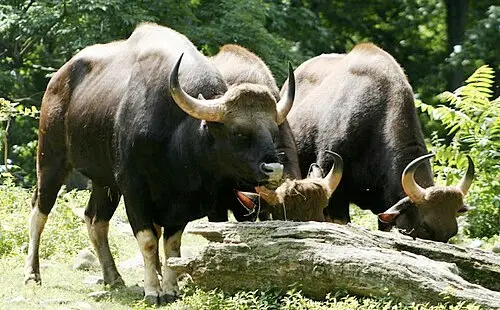
 📸 Photo
Photo: Cyndy Sims Parr · CC BY-SA 2.0 · Wikimedia Commons Source
Gaur
Bos gaurus (Gaur · ガウル)
💡 Everyday Comparisons for Size, Mass & Speed
- 💡 Its shoulder height of 2.2 m is taller than a standard doorway (about 2 m) (Comparison).
- 💡 A weight of 1,000 kg equals 50 bags of 20 kg rice (Comparison).
- 💡 People have hunted this wild cattle species as a sport-hunting trophy (Animal Diversity Web).
Reference standards: coach bus ~12 m, mid-size car ~4.9 m, compact car ~1 t, basketball hoop 3.05 m, credit card 8.56 cm.
Site-computed relative index from recorded values; not a formal scientific metric.
📖 1. Overview
The gaur is among the largest of all wild cattle, living on forested hills from Nepal and India through Indochina to the Malay Peninsula.
🦴 2. Anatomy & Morphology
Its coat ranges from dark reddish brown to blackish brown, with white stocking-like markings on its legs. Both males and females have horns measuring 0.6–1.15 m, and a muscular ridge rises like a hump over the shoulders.
🔍 3. Ecology & Behavior
It emerges from the forest into grasslands in the morning to graze, then rests and ruminates during the day. Herds usually consist of 8–11 individuals, and the gestation period is 270–280 days.
🇰🇷 4. Connection to Korea
No direct record connecting this species to Korea has been found.
📚 Sources & References
- • IUCN Red List category VU — latest assessment at iucnredlist.org
- • mammaldiversity.org — 1006260
- • iucnredlist.org — 2891
- • wikidata.org — Q174296
- • commons.wikimedia.org — File:Gaur at the Bronx Zoo.jpg
- • animaldiversity.org — Bos frontalis
- • Silhouette: PhyloPic — Cristopher Silva · CC0 1.0
Recorded dimensions are widely cited representative estimates from public literature and may vary by study or specimen.