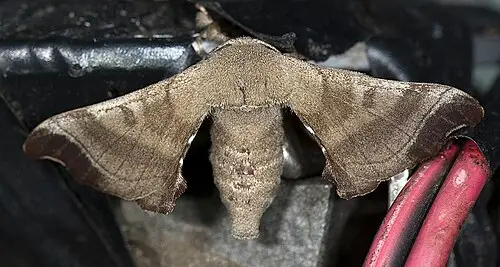
 📸 Photo
Photo: LiCheng Shih · CC BY 2.0 · Wikimedia Commons Source
Wild silkmoth
Bombyx mandarina (Wild silkmoth · クワコ)
Not Evaluated (NE) on the IUCN Red List yet.
💡 Everyday Comparisons for Size, Mass & Speed
- 💡 Its wingspan of 4 cm is about one and a half Korean 500-won coins (diameter 2.65 cm) (Comparison).
- 💡 Because it is regarded as the wild form of the silk-producing silkworm and produces hybrids when crossed with the domesticated silkmoth, it can be classified as an industrial insect (National List of Species of Korea).
Reference standards: coach bus ~12 m, mid-size car ~4.9 m, compact car ~1 t, basketball hoop 3.05 m, credit card 8.56 cm.
📖 1. Overview
The wild silkmoth is a moth similar to the domesticated silkmoth and is considered the wild form of the silkworm. It lives along the edges of deciduous broadleaf forests in mountainous areas.
🦴 2. Anatomy & Morphology
Its body and wings are grayish-brown with an olive tint, and females are slightly paler. Both males and females have comb-shaped antennae, and at the center of the outer margin of the hindwing there is a black marking bordered by a thin white line.
🔍 3. Ecology & Behavior
The caterpillars eat leaves of mulberry and mountain mulberry trees. It appears twice a year from mid-May to November and flies toward lights at night. It can actually produce hybrids with the domesticated silkmoth.
🇰🇷 4. Connection to Korea
It is distributed throughout Korea, and the National List of Species of Korea notes that it can be classified as an industrial insect.
📚 Sources & References
- • IUCN Red List: not evaluated (NE) — cross-checked with the Wikidata conservation-status entry
- • catalogueoflife.org — 93VSN
- • 국가생물종목록(국립생물자원관) ktsn 120000031703 — https://species.nibr.go.kr/home/mainHome.do?cont_link=009&subMenu=009002&contCd=009002&ktsn=120000031703
- • wikidata.org — Q144548
- • commons.wikimedia.org — File:Bombyx mandarina formosana (16538814785) (cropped).jpg
- • species.nibr.go.kr — mainHome.do
- • Silhouette: PhyloPic — Gemma Martínez-Redondo · CC0 1.0 (Congeneric silhouette — Bombyx mori)
Recorded dimensions are widely cited representative estimates from public literature and may vary by study or specimen.