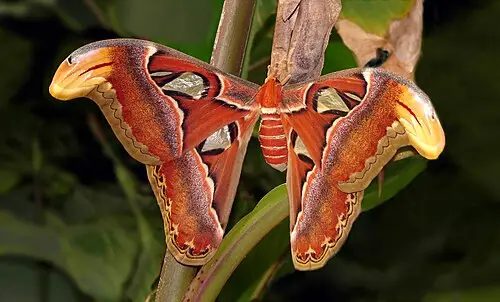
 📸 Photo
Photo: London_Zoo_01118.jpg : Nevit Dilmen ( talk ) derivative work: Hic et nunc · CC BY-SA 3.0 · Wikimedia Commons Source
Atlas moth
Attacus atlas (Atlas moth · ヨナグニサン)
Not Evaluated (NE) on the IUCN Red List yet.
💡 Everyday Comparisons for Size, Mass & Speed
- 💡 Its maximum wingspan of 25 cm is 4 cm longer than the short side of an A4 sheet of paper (21 cm).
- 💡 Brown silk obtained from its cocoons has been woven into a fabric called fagara silk in East Asia, and because it is easy to rear, it is popular as a pet insect and used in zoos and museums to showcase insect diversity (ADW).
Reference standards: coach bus ~12 m, mid-size car ~4.9 m, compact car ~1 t, basketball hoop 3.05 m, credit card 8.56 cm.
📖 1. Overview
The Atlas moth (Attacus atlas) is a giant moth of the family Saturniidae whose wingspan ranks among the top five largest moths in the world. It lives mainly in tropical and subtropical rainforests and has no record in the National List of Species of Korea.
🦴 2. Anatomy & Morphology
Females are larger than males. Wingspan is 240 to 250 mm in females and 210 to 230 mm in males, with rounded wings. Forewing length averages 102 mm in males and 119 mm in females.
🔍 3. Ecology & Behavior
Larvae eat only the leaves of host plants, and because eggs, pupae, and adults do not feed, the large caterpillars consume vast amounts of leaves to store energy. Females attract males with pheromones, and mating begins at dusk and lasts up to 24 hours.
🇰🇷 4. Connection to Korea
No direct record connecting this species to Korea has been found.
📚 Sources & References
- • IUCN Red List: not evaluated (NE) — cross-checked with the Wikidata conservation-status entry
- • catalogueoflife.org — JMDM
- • wikidata.org — Q167435
- • commons.wikimedia.org — File:Attacus atlas London Zoo 01118-2.jpg
- • animaldiversity.org — Attacus atlas
- • Silhouette: PhyloPic — Lauren Otolski · CC0 1.0 (Related taxon silhouette — Eacles imperialis)
Recorded dimensions are widely cited representative estimates from public literature and may vary by study or specimen.