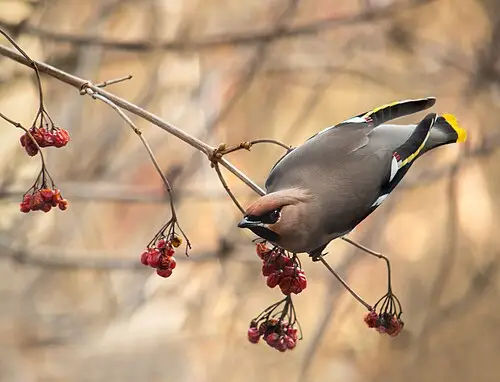
 📸 Photo
Photo: Frank Vassen from Brussels, Belgium · CC BY 2.0 · Wikimedia Commons Source
Bohemian Waxwing
Bombycilla garrulus (Bohemian Waxwing · キレンジャク)
💡 Everyday Comparisons for Size, Mass & Speed
- 💡 Its body mass of 69 g is similar to one chicken egg (about 60 g) (Comparison).
- 💡 According to the National List of Species of Korea, it is a common winter visitor nationwide that mainly eats plant food, so flocks of 10–30 birds can be seen perched on winter trees with remaining fruit.
Reference standards: coach bus ~12 m, mid-size car ~4.9 m, compact car ~1 t, basketball hoop 3.05 m, credit card 8.56 cm.
Site-computed relative index from recorded values; not a formal scientific metric.
📖 1. Overview
The Bohemian waxwing is a starling-sized bird with a raised crest on its head and a yellow tip on its tail. It breeds in northern Eurasia and North America and visits Korea in flocks during winter.
🦴 2. Anatomy & Morphology
It is grayish overall with a chestnut wash on the face and a yellow band at the tip of the tail. The name 'waxwing' comes from the red, wax-like tips on its wing feathers.
🔍 3. Ecology & Behavior
Sugary fruits are its main food, and in summer it also catches flying insects such as mosquitoes and midges. Its large liver converts sugar into energy and also breaks down ethanol from fermented fruit.
🇰🇷 4. Connection to Korea
The National List of Species of Korea records it as a common winter visitor found nationwide, forming flocks of 10–30 and sometimes up to 100 birds in winter.
📚 Sources & References
- • IUCN Red List LC (2025) — https://www.iucnredlist.org/species/22708146/137483083
- • IUCN Red List category LC — latest assessment at iucnredlist.org
- • doi.org — avilist.v2026
- • iucnredlist.org — 137483083
- • 국가생물종목록(국립생물자원관) ktsn 120000001971 — https://species.nibr.go.kr/home/mainHome.do?cont_link=009&subMenu=009002&contCd=009002&ktsn=120000001971
- • wikidata.org — Q26135
- • commons.wikimedia.org — File:Bohemian waxwing (Bombycilla garrulus), Uitkerke, Belgi
- • animaldiversity.org — Bombycilla garrulus
- • species.nibr.go.kr — mainHome.do
- • Silhouette: PhyloPic — Andy Wilson · CC0 1.0 (Congeneric silhouette — Bombycilla cedrorum)
Recorded dimensions are widely cited representative estimates from public literature and may vary by study or specimen.