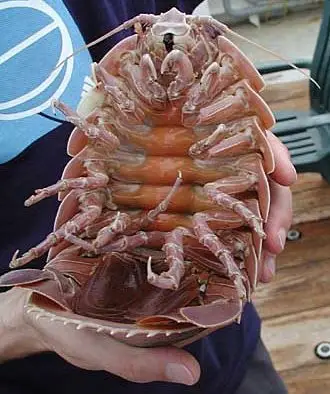
 📸 Photo
Photo: NOAA · Public domain · Wikimedia Commons Source
Giant isopod
Bathynomus giganteus (Giant isopod · ダイオウグソクムシ)
Not Evaluated (NE) on the IUCN Red List yet.
💡 Everyday Comparisons for Size, Mass & Speed
- 💡 Its maximum body length of 50 cm is slightly more than half the length of a baseball bat (about 85 cm).
- 💡 SeaLifeBase notes that this isopod is caught as bycatch in baited trap fisheries such as those for golden crab (Chaceon fenneri), and classifies it as being 'of no interest' to commercial fisheries. It is a deep-sea scavenger lured into traps lowered into the deep ocean.
Reference standards: coach bus ~12 m, mid-size car ~4.9 m, compact car ~1 t, basketball hoop 3.05 m, credit card 8.56 cm.
📖 1. Overview
The giant isopod (Bathynomus giganteus) is the largest known isopod, living on the deep continental slopes of the Indo-West Pacific and Western Atlantic.
🦴 2. Anatomy & Morphology
Its body is flattened without a distinct carapace, and the first thoracic segment is fused to the head. Its eyes are sessile (stalkless), and its tail fan is shaped like a flared fin. It has mouthparts adapted to cut and swallow large prey, a large distensible gut, and the ability to store large amounts of lipid in its hepatopancreas.
🔍 3. Ecology & Behavior
Because it is frequently caught in baited traps, it is believed to be a carrion-feeding scavenger.
🇰🇷 4. Connection to Korea
No direct record connecting this species to Korea has been found.
📚 Sources & References
- • IUCN Red List: not evaluated (NE) — cross-checked with the Wikidata conservation-status entry
- • marinespecies.org — aphia.php
- • wikidata.org — Q1366514
- • commons.wikimedia.org — File:Giant isopod.jpg
- • sealifebase.se — Bathynomus-giganteus.html
Recorded dimensions are widely cited representative estimates from public literature and may vary by study or specimen.