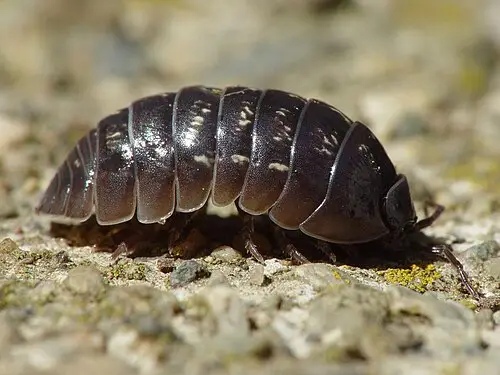
 📸 Photo
Photo: Franco Folini · CC BY 2.5 · Wikimedia Commons Source
Common pill bug
Armadillidium vulgare (Common pill bug · オカダンゴムシ)
Not Evaluated (NE) on the IUCN Red List yet.
💡 Everyday Comparisons for Size, Mass & Speed
- 💡 Its body length of 18 mm is about 2/3 the diameter of a 500-won coin (26.5 mm).
- 💡 It also lives in cities, residential areas, and farmland, sometimes eating pieces of carrot root or lettuce leaves in kitchen gardens.
Reference standards: coach bus ~12 m, mid-size car ~4.9 m, compact car ~1 t, basketball hoop 3.05 m, credit card 8.56 cm.
Site-computed relative index from recorded values; not a formal scientific metric.
📖 1. Overview
The common pill bug (Armadillidium vulgare) is a terrestrial isopod (crustacean) that rolls its body into a ball when touched, living under leaf litter in forests, cities, and farmland.
🦴 2. Anatomy & Morphology
Its body is a flattened oval about 2 times as long as it is wide, covered by a thick, hard shell. Its trunk has glands that release unpleasant secretions, and when threatened it rolls its rear segments toward the front segments to form a ball.
🔍 3. Ecology & Behavior
Primarily a decomposer feeding on decaying leaf litter, it also eats dead animals during droughts as well as pieces of carrot root or fruit. Nearly 10% of its diet is obtained by re-ingesting its own feces.
🇰🇷 4. Connection to Korea
No direct record connecting this species to Korea has been found.
📚 Sources & References
- • IUCN Red List: not evaluated (NE) — cross-checked with the Wikidata conservation-status entry
- • catalogueoflife.org — GRLD
- • 국가생물종목록(국립생물자원관) ktsn 120000370185 — https://species.nibr.go.kr/home/mainHome.do?cont_link=009&subMenu=009002&contCd=009002&ktsn=120000370185
- • wikidata.org — Q1300629
- • commons.wikimedia.org — File:Armadillidium vulgare 001.jpg
- • animaldiversity.org — Armadillidium vulgare
- • Silhouette: PhyloPic — Christoph Schomburg · CC0 1.0
Recorded dimensions are widely cited representative estimates from public literature and may vary by study or specimen.