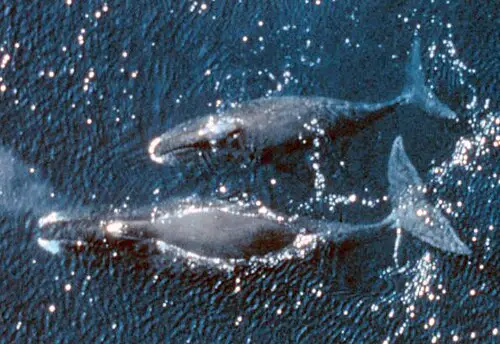
 📸 Photo
Photo: Public domain · Public domain · Wikimedia Commons Source
Bowhead Whale
Balaena mysticetus (Bowhead Whale · ホッキョククジラ)
💡 Everyday Comparisons for Size, Mass & Speed
- 💡 It can break through sea ice about 20 cm (8 inches) thick with its head, and its lifespan is estimated to exceed 200 years.
- 💡 Alaska Natives and other indigenous peoples have long used its meat for food, baleen for tools, and blubber for fuel.
- 💡 Its maximum body length of 18 m is about one and a half city buses (about 12 m) (Comparison).
Reference standards: coach bus ~12 m, mid-size car ~4.9 m, compact car ~1 t, basketball hoop 3.05 m, credit card 8.56 cm.
Site-computed relative index from recorded values; not a formal scientific metric.
📖 1. Overview
The bowhead whale is a giant baleen whale of Arctic waters, the second-largest whale in the world, characterized by its bow-shaped mouth.
🦴 2. Anatomy & Morphology
Its body is black with a white front chin. Its baleen plates are the longest of any whale, numbering about 300 and measuring 3–4.5 m vertically. Its skull makes up about one-third (1/3) of its body length, and together with a very thick blubber layer allows it to break through sea ice with its head.
🔍 3. Ecology & Behavior
It uses its baleen plates to filter small crustaceans such as copepods and krill, consuming about 100 tons a year. In spring and fall it migrates in size-segregated groups following changes in sea ice.
🇰🇷 4. Connection to Korea
No direct record connecting this species to Korea has been found.
📚 Sources & References
- • IUCN Red List LC (2018) — https://www.iucnredlist.org/species/2467/50347659
- • IUCN Red List category LC — latest assessment at iucnredlist.org
- • mammaldiversity.org — 1006393
- • iucnredlist.org — 50347659
- • wikidata.org — Q174652
- • commons.wikimedia.org — File:Bowheads42.jpg
- • animaldiversity.org — Balaena mysticetus
- • fisheries.noaa.gov — bowhead-whale
- • Silhouette: PhyloPic — author not recorded · Public Domain Mark 1.0
Recorded dimensions are widely cited representative estimates from public literature and may vary by study or specimen.