 📸 Photo
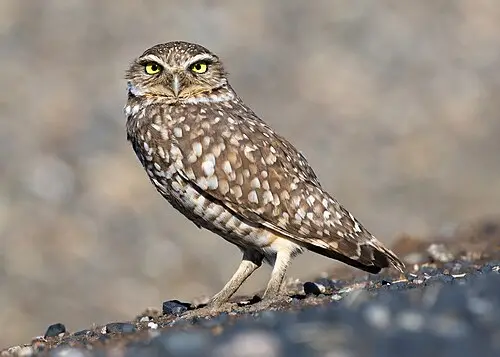
Photo: Frank Schulenburg · CC BY-SA 4.0 · Wikimedia Commons Source
Burrowing Owl
Athene cunicularia (Burrowing Owl · アナホリフクロウ)
💡 Everyday Comparisons for Size, Mass & Speed
- 💡 Its maximum weight of 255 g is about four eggs, and its 25 cm height is slightly shorter than the long side of an A4 sheet (about 30 cm).
- 💡 It can even be seen near people in urban vacant lots, airports, and golf courses (ADW habitat notes).
- 💡 An annual festival in late February (month 2) celebrates this owl and the Whooping Crane for birdwatchers, and webcams let viewers watch inside its burrows online (ADW).
Reference standards: coach bus ~12 m, mid-size car ~4.9 m, compact car ~1 t, basketball hoop 3.05 m, credit card 8.56 cm.
Site-computed relative index from recorded values; not a formal scientific metric.
📖 1. Overview
The Burrowing Owl is a small owl of American deserts, grasslands, and plains that lives in burrows abandoned by animals such as badgers or prairie dogs. Unlike most owls, it lives mainly on the ground.
🦴 2. Anatomy & Morphology
It has a small body, long legs, a short tail, bright yellow eyes, white eyebrows, and no ear tufts. Its brown plumage is barred across the chest.
🔍 3. Ecology & Behavior
Arthropods such as grasshoppers, crickets, and beetles make up about 90% of its diet, supplemented by mice, ground squirrels, small birds, snakes, and lizards. It hunts by walking and running on the ground or hovering in the air. Pairs are monogamous and raise 2–12 young per brood.
🇰🇷 4. Connection to Korea
No direct record connecting this species to Korea has been found.
📚 Sources & References
- • IUCN Red List LC (2025) — https://www.iucnredlist.org/species/22689353/281015958
- • IUCN Red List category LC — latest assessment at iucnredlist.org
- • doi.org — avilist.v2026
- • iucnredlist.org — 281015958
- • wikidata.org — Q467068
- • commons.wikimedia.org — File:Western burrowing owl, Glenn County-0550.jpg
- • animaldiversity.org — Athene cunicularia
- • nationalzoo.si.edu — burrowing-owl
- • Silhouette: PhyloPic — Caleb M. Gordon · CC BY 4.0
Recorded dimensions are widely cited representative estimates from public literature and may vary by study or specimen.