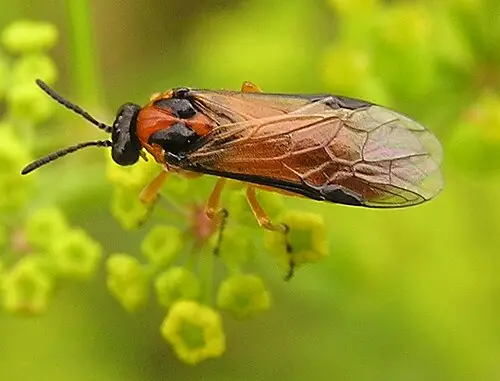
 📸 Photo
Photo: Michael Becker · CC BY-SA 3.0 · Wikimedia Commons Source
Turnip sawfly
Athalia rosae (Turnip sawfly · カブラハバチ)
Not Evaluated (NE) on the IUCN Red List yet.
💡 Everyday Comparisons for Size, Mass & Speed
- 💡 It is a pest that chews holes in the leaves of radish and napa cabbage fields, key ingredients for the kimchi-making season.
- 💡 Its maximum adult body length of 8 mm is less than half the diameter of a 10-won coin (18 mm).
Reference standards: coach bus ~12 m, mid-size car ~4.9 m, compact car ~1 t, basketball hoop 3.05 m, credit card 8.56 cm.
📖 1. Overview
The turnip sawfly (Athalia rosae) is a small sawfly with an orange body that is a pest feeding on the leaves of cruciferous plants such as radish, napa cabbage, and rapeseed.
🦴 2. Anatomy & Morphology
Adults have a body length of 7 to 8 mm with an entirely orange abdomen, an orange thorax bearing two black shoulder plates, and orange legs with black bands. The larvae have a glossy black head and a dark greenish-black body, growing up to 18 mm.
🔍 3. Ecology & Behavior
According to British records, it overwinters underground as a pupa, and first-generation adults emerge in May to June, laying up to 300 eggs along leaf margins. Larvae chew the leaves until only veins remain, while adults feed on pollen and nectar.
🇰🇷 4. Connection to Korea
In a survey of greenhouse vegetable pests in the Jeonbuk region, the turnip sawfly was one of 9 pest species that caused major damage to cruciferous (Brassicaceae) vegetables.
📚 Sources & References
- • IUCN Red List: not evaluated (NE) — cross-checked with the Wikidata conservation-status entry
- • checklistbank.org — LJVX7
- • 국가생물종목록(국립생물자원관) ktsn 120000031154 — https://species.nibr.go.kr/home/mainHome.do?cont_link=009&subMenu=009002&contCd=009002&ktsn=120000031154
- • wikidata.org — Q1680271
- • commons.wikimedia.org — File:Athalia rosae 2006.08.12 15.36.24-p8120093.jpg
- • ahdb.org.uk — turnip-sawfly-biology-and-impact-on-vegetable-brassicas-and-
- • db.koreascholar.com — 10401
- • bok.or.kr — contents.do
- • Silhouette: PhyloPic — author not recorded · CC0 1.0 (Related taxon silhouette — Nematus ribesii)
Recorded dimensions are widely cited representative estimates from public literature and may vary by study or specimen.