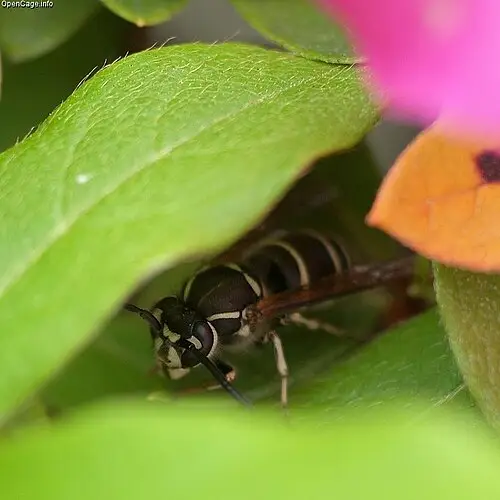
 📸 Photo
Photo: Daiju Azuma · CC BY-SA 2.5 · Wikimedia Commons Source
Common Asian yellowjacket
Vespula flaviceps (Common Asian yellowjacket · クロスズメバチ)
Not Evaluated (NE) on the IUCN Red List yet.
💡 Everyday Comparisons for Size, Mass & Speed
- 💡 A queen's body length of about 1.3 cm is about half the diameter of a Korean 500-won coin (2.65 cm) (Comparison).
- 💡 A mature colony's diameter of about 40 cm is longer than the long side of an A4 sheet of paper (29.7 cm) (Comparison; figure from a Zootaxa paper reporting accounts from local residents in Vietnam).
Reference standards: coach bus ~12 m, mid-size car ~4.9 m, compact car ~1 t, basketball hoop 3.05 m, credit card 8.56 cm.
📖 1. Overview
The common Asian yellowjacket (Vespula flaviceps) is a wasp in the family Vespidae, widely distributed from Pakistan through Indochina to Amami Island in the Ryukyus and Amur, Primorye, and Sakhalin in Russia.
🦴 2. Anatomy & Morphology
Based on Vietnamese specimens, queens have a body length of 12.6–12.8 mm and a forewing length of 12.0–12.2 mm. The body is black with yellow markings on the face, thorax, and margins of the abdominal segments.
🔍 3. Ecology & Behavior
In Vietnam, queens have been observed flying low over the ground in late July searching for nest sites. According to locals, colonies reach about 40 cm in diameter and 4–5 tiers by February of the following year.
🇰🇷 4. Connection to Korea
It is listed as 'Ttangbeol' (Korean name) in the National List of Species of Korea.
📚 Sources & References
- • IUCN Red List: not evaluated (NE) — cross-checked with the Wikidata conservation-status entry
- • catalogueoflife.org — 7FR7S
- • 국가생물종목록(국립생물자원관) ktsn 120000031639 — https://species.nibr.go.kr/home/mainHome.do?cont_link=009&subMenu=009002&contCd=009002&ktsn=120000031639
- • wikidata.org — Q2717214
- • commons.wikimedia.org — File:Vespula flaviceps.jpg
- • tb.plazi.org — 039687CF043EFFE3B0E7F6D64A3EA5C3
- • Silhouette: PhyloPic — Richard J. Harris · Public Domain Mark 1.0 (Congeneric silhouette — Vespula vulgaris)
Recorded dimensions are widely cited representative estimates from public literature and may vary by study or specimen.