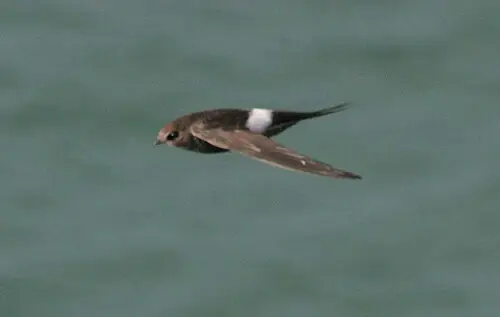
 📸 Photo
Photo: Robert Pudwill · CC BY-SA 3.0 · Wikimedia Commons Source
Fork-tailed Swift
Apus pacificus (Fork-tailed Swift · アマツバメ)
💡 Everyday Comparisons for Size, Mass & Speed
- 💡 It breeds not only on coastal island cliffs but also on tall old buildings (Encyclopedia of Korean Culture).
- 💡 Its body length of about 18 cm is similar to one unsharpened pencil (Comparison).
Reference standards: coach bus ~12 m, mid-size car ~4.9 m, compact car ~1 t, basketball hoop 3.05 m, credit card 8.56 cm.
Site-computed relative index from recorded values; not a formal scientific metric.
📖 1. Overview
The Fork-tailed Swift is a sleek bird about 18 cm long that spends most of the year in the air and lands only to breed. It visits Korea as a not-uncommon breeding summer visitor.
🦴 2. Anatomy & Morphology
Its legs are very short and its wings are very long, so it cannot take off from the ground. Its body is blackish brown with only a white rump.
🔍 3. Ecology & Behavior
On the wing, it catches insects such as flies, beetles, bees, and cicadas, and even mates in midair. Nesting in colonies on cliffs, it glues grasses together with saliva and lays 2–3 eggs in June–July (months 6–7).
🇰🇷 4. Connection to Korea
A summer visitor that breeds not uncommonly in Korea, its breeding ground (the Sinan Chilbaldo Seabird Breeding Site) was designated as a Natural Monument (Korea) in 1982. The species itself has no conservation status listed in the National List of Species of Korea.
📚 Sources & References
- • IUCN Red List LC (2024) — https://www.iucnredlist.org/species/22686845/263660872
- • IUCN Red List category LC — latest assessment at iucnredlist.org
- • doi.org — avilist.v2026
- • iucnredlist.org — 263660872
- • 국가생물종목록(국립생물자원관) ktsn 120000001883 — https://species.nibr.go.kr/home/mainHome.do?cont_link=009&subMenu=009002&contCd=009002&ktsn=120000001883
- • wikidata.org — Q31866
- • commons.wikimedia.org — File:ApusPacificus.jpg
- • nzbirdsonline.org.nz — fork-tailed-swift
- • encykorea.aks.ac.kr — E0058611
- • Silhouette: PhyloPic — Andy Wilson · CC0 1.0 (Congeneric silhouette — Apus apus)
Recorded dimensions are widely cited representative estimates from public literature and may vary by study or specimen.