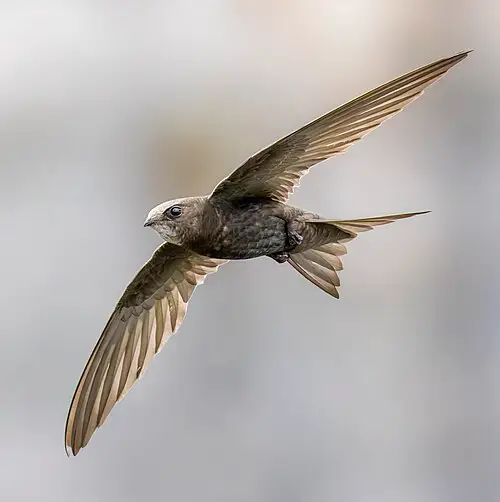
 📸 Photo
Photo: Alexis Lours · CC BY 4.0 · Wikimedia Commons Source
Common Swift
Apus apus (Common Swift · ヨーロッパアマツバメ)
💡 Everyday Comparisons for Size, Mass & Speed
- 💡 Its weight of 44.9 g is lighter than one egg, and its wingspan of 48 cm is slightly longer than the long side of a sheet of A3 paper (42 cm) (Comparison).
- 💡 Living close to people, it nests in man-made structures such as building crevices and chimneys and also eats pest insects like mosquitoes (Animal Diversity Web).
Reference standards: coach bus ~12 m, mid-size car ~4.9 m, compact car ~1 t, basketball hoop 3.05 m, credit card 8.56 cm.
Site-computed relative index from recorded values; not a formal scientific metric.
📖 1. Overview
The Common Swift spends most of the day on the wing, breeding across Europe and Asia and spending the winter in Africa.
🦴 2. Anatomy & Morphology
Its body is blackish brown except for a whitish chin and throat, with narrow sickle-shaped wings and a shallowly forked tail. Though it resembles a swallow, its wing shape and flight style are different.
🔍 3. Ecology & Behavior
It catches flying insects such as aphids, bees, ants, beetles, and flies in its mouth and binds them with saliva in its throat into a food bolus to carry back. During the breeding season it is estimated to fly at least 560 miles (about 900 km) a day, mating and foraging on the wing.
🇰🇷 4. Connection to Korea
It is listed in the National List of Species of Korea under the name "geomeundeung-kalsae" (Korean name).
📚 Sources & References
- • IUCN Red List LC (2025) — https://www.iucnredlist.org/species/22686800/281017590
- • IUCN Red List category LC — latest assessment at iucnredlist.org
- • doi.org — avilist.v2026
- • iucnredlist.org — 281017590
- • 국가생물종목록(국립생물자원관) ktsn 120000533849 — https://species.nibr.go.kr/home/mainHome.do?cont_link=009&subMenu=009002&contCd=009002&ktsn=120000533849
- • wikidata.org — Q25377
- • commons.wikimedia.org — File:Common Swift 2025 07 18 02 (cropped).jpg
- • animaldiversity.org — Apus apus
- • species.nibr.go.kr — mainHome.do
- • Silhouette: PhyloPic — Andy Wilson · CC0 1.0
Recorded dimensions are widely cited representative estimates from public literature and may vary by study or specimen.