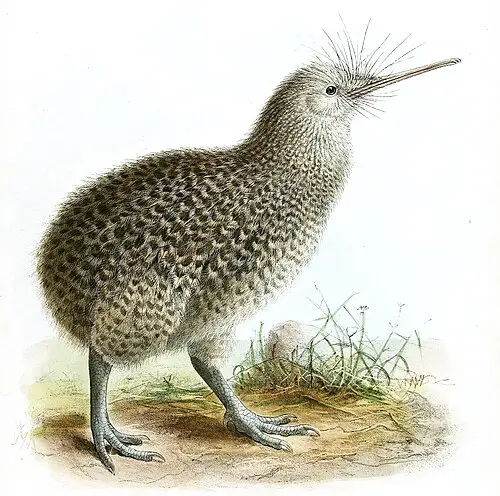
 📸 Photo
Photo: John Gerrard Keulemans · Public domain · Wikimedia Commons Source
Little Spotted Kiwi
Apteryx owenii (Little Spotted Kiwi · コマダラキーウィ)
💡 Everyday Comparisons for Size, Mass & Speed
- 💡 Its body length of 30 cm equals the long side of a sheet of A4 paper (29.7 cm), and a female's weight of 1.35 kg is lighter than one 1.5 L bottle of water (Comparison).
- 💡 It is conserved by translocation to several offshore islands and fenced sanctuaries, including Zealandia in Wellington, New Zealand (NZ Birds Online).
Reference standards: coach bus ~12 m, mid-size car ~4.9 m, compact car ~1 t, basketball hoop 3.05 m, credit card 8.56 cm.
Site-computed relative index from recorded values; not a formal scientific metric.
📖 1. Overview
The Little Spotted Kiwi is the smallest of the five kiwi species; once widespread across both main islands of New Zealand, it now lives mainly on offshore islands and in fenced sanctuaries.
🦴 2. Anatomy & Morphology
It has pale brownish-gray feathers with white horizontal mottling, a long pale bill, and short pale legs. Its wings are tiny and vestigial, and it has no tail.
🔍 3. Ecology & Behavior
Searching for food on the forest floor at night by sound and smell, it eats earthworms, beetle larvae, spiders, and fruits. It hides in burrows by day, and chicks begin foraging on their own about 5–7 days after hatching.
🇰🇷 4. Connection to Korea
No direct record connecting this species to Korea has been found.
📚 Sources & References
- • IUCN Red List NT (2022) — https://www.iucnredlist.org/species/22678129/214096691
- • IUCN Red List category NT — latest assessment at iucnredlist.org
- • doi.org — avilist.v2026
- • iucnredlist.org — 214096691
- • wikidata.org — Q244197
- • commons.wikimedia.org — File:Apteryx owenii 0.jpg
- • nzbirdsonline.org.nz — little-spotted-kiwi-kiwi-pukupuku
- • animaldiversity.org — Apteryx owenii
- • doc.govt.nz — little-spotted-kiwi
- • Silhouette: PhyloPic — Ferran Sayol · CC0 1.0 (Congeneric silhouette — Apteryx)
Recorded dimensions are widely cited representative estimates from public literature and may vary by study or specimen.