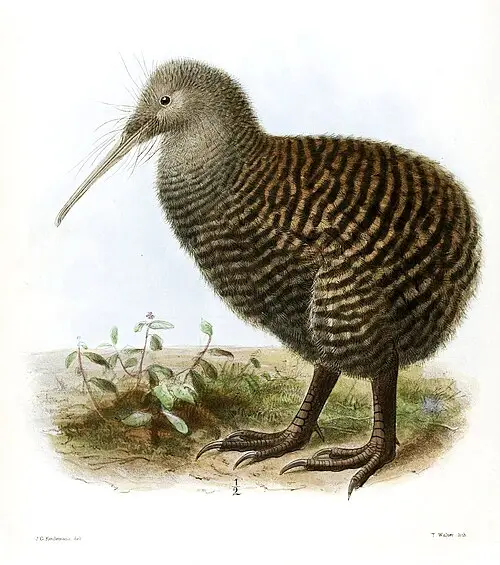
 📸 Photo
Photo: John Gerrard Keulemans · Public domain · Wikimedia Commons Source
Great Spotted Kiwi
Apteryx maxima (Great Spotted Kiwi · Great Spotted Kiwi)
Not Evaluated (NE) on the IUCN Red List yet.
💡 Everyday Comparisons for Size, Mass & Speed
- 💡 Its body length of 55 cm is about 2/3 the length of a full-size umbrella (about 80 cm), and its weight of 3.3 kg is lighter than one watermelon (around 5 kg) (Comparison).
- 💡 Hikers walking the Heaphy Track in New Zealand can hear its trilling calls at night (New Zealand Department of Conservation, DOC).
Reference standards: coach bus ~12 m, mid-size car ~4.9 m, compact car ~1 t, basketball hoop 3.05 m, credit card 8.56 cm.
Site-computed relative index from recorded values; not a formal scientific metric.
📖 1. Overview
The Great Spotted Kiwi (roroa) is the largest of the kiwis and lives in the mountainous northwest of New Zealand's South Island.
🦴 2. Anatomy & Morphology
Its mottled plumage mixes gray, brown, and white, and it has short muscular legs and a long bill (8–13 cm). Females are larger than males and have longer bills.
🔍 3. Ecology & Behavior
At night it eats earthworms (40–45% of its diet) and other invertebrates such as insects, along with fruits and seeds. It lays one egg a year and incubates it for about 70 days, with the male doing most of the incubation.
🇰🇷 4. Connection to Korea
No direct record connecting this species to Korea has been found.
📚 Sources & References
- • IUCN Red List: not evaluated (NE) — cross-checked with the Wikidata conservation-status entry
- • doi.org — avilist.v2026
- • wikidata.org — Q21365526
- • commons.wikimedia.org — File:ApteryxHaastiiKeulemans.jpg
- • animaldiversity.org — Apteryx haastii
- • doc.govt.nz — great-spotted-kiwi-roroa
- • nzbirdsonline.org.nz — great-spotted-kiwi
- • birdsoftheworld.org — introduction
- • Silhouette: PhyloPic — Ferran Sayol · CC0 1.0 (Congeneric silhouette — Apteryx)
Recorded dimensions are widely cited representative estimates from public literature and may vary by study or specimen.