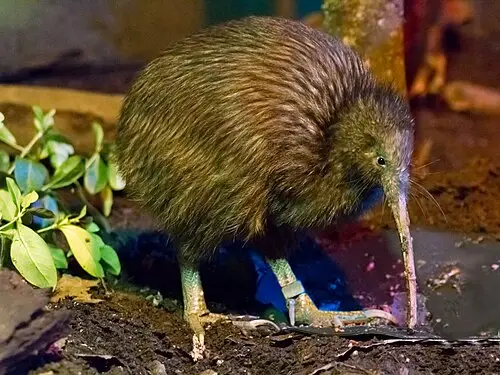
 📸 Photo
Photo: The.Rohit · CC BY 2.0 · Wikimedia Commons Source
North Island Brown Kiwi
Apteryx mantelli (North Island Brown Kiwi · ノースアイランドブラウンキーウィ)
💡 Everyday Comparisons for Size, Mass & Speed
- 💡 Roaming dogs on walks are the biggest threat to adult kiwis.
- 💡 Its weight of 3.9 kg is about 40% of a 10 kg bag of rice (Comparison).
- 💡 A single egg accounts for about 15% of the female's body weight, and its average length of 124 mm is more than half the short side of a sheet of A4 paper (210 mm) (Comparison).
Reference standards: coach bus ~12 m, mid-size car ~4.9 m, compact car ~1 t, basketball hoop 3.05 m, credit card 8.56 cm.
Site-computed relative index from recorded values; not a formal scientific metric.
📖 1. Overview
The North Island Brown Kiwi is a small flightless bird active at night and found only on the North Island of New Zealand.
🦴 2. Anatomy & Morphology
It has only tiny vestigial wings, no tail, hair-like feathers, and a long curved bill. With nostrils at the tip of its bill, it finds food by smell rather than sight, and has small eyes and large ear openings.
🔍 3. Ecology & Behavior
At night it probes the ground to eat small invertebrates such as earthworms, beetle larvae, and cicada nymphs, along with some fallen berries. It nests in burrows or hollow logs, and the male incubates the egg for 75–90 days.
🇰🇷 4. Connection to Korea
No direct record connecting this species to Korea has been found.
📚 Sources & References
- • IUCN Red List VU (2017) — https://www.iucnredlist.org/species/45353580/119177586
- • IUCN Red List category VU — latest assessment at iucnredlist.org
- • doi.org — avilist.v2026
- • iucnredlist.org — 119177586
- • wikidata.org — Q734829
- • commons.wikimedia.org — File:Apteryx mantelli -Rotorua, North Island, New Zealand-8a
- • nzbirdsonline.org.nz — north-island-brown-kiwi
- • nationalzoo.si.edu — north-island-brown-kiwi
- • doc.govt.nz — facts
- • Silhouette: PhyloPic — Ferran Sayol · CC0 1.0 (Congeneric silhouette — Apteryx)
Recorded dimensions are widely cited representative estimates from public literature and may vary by study or specimen.