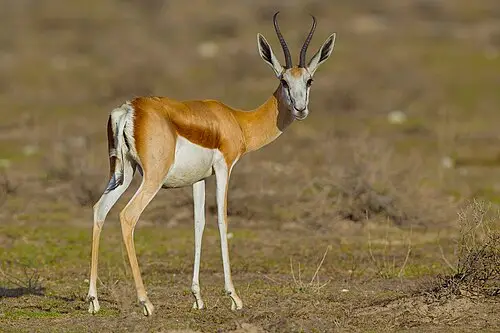
 📸 Photo
Photo: Yathin S Krishnappa · CC BY-SA 3.0 · Wikimedia Commons Source
Springbok
Antidorcas marsupialis (Springbok · スプリングボック)
💡 Everyday Comparisons for Size, Mass & Speed
- 💡 The springbok is the national sporting emblem of the Republic of South Africa (Animal Diversity Web).
- 💡 A pronking leap of 3.5 m is 1.4 times the height of a single apartment story (about 2.5 m) (Comparison).
- 💡 It is a popular attraction for tourists at game reserves and private farms (Animal Diversity Web).
Reference standards: coach bus ~12 m, mid-size car ~4.9 m, compact car ~1 t, basketball hoop 3.05 m, credit card 8.56 cm.
Site-computed relative index from recorded values; not a formal scientific metric.
📖 1. Overview
The springbok is a gazelle-like antelope of southern Africa, famous for leaping high into the air with stiff legs when startled.
🦴 2. Anatomy & Morphology
Its face is white with black stripes running from the eyes to the mouth, while its back and flanks are reddish brown and its rump is white. A fold of skin running from the middle of the back to the rump opens to reveal a crest of white hair.
🔍 3. Ecology & Behavior
It switches between grasses and leaves seasonally, obtaining moisture from flowers when water is scarce. When startled, it performs "pronking," leaping up to 3.5 m high with its head lowered and back arched.
🇰🇷 4. Connection to Korea
No direct record connecting this species to Korea has been found.
📚 Sources & References
- • IUCN Red List LC (2016) — https://www.iucnredlist.org/species/1676/115056763
- • IUCN Red List category LC — latest assessment at iucnredlist.org
- • mammaldiversity.org — 1006138
- • iucnredlist.org — 115056763
- • wikidata.org — Q213084
- • commons.wikimedia.org — File:Antidorcas marsupialis, female (Etosha, 2012).jpg
- • animaldiversity.org — Antidorcas marsupialis
- • Silhouette: PhyloPic — Robert Hering · CC BY 3.0
Recorded dimensions are widely cited representative estimates from public literature and may vary by study or specimen.