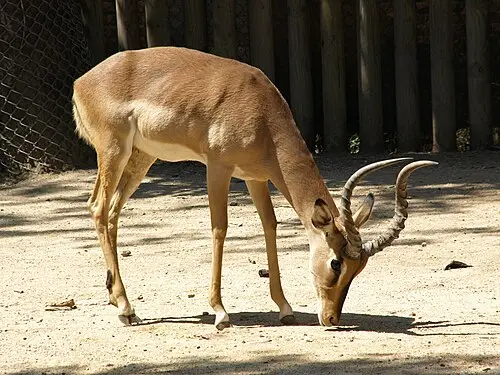
 📸 Photo
Photo: Mutari · CC BY-SA 3.0 · Wikimedia Commons Source
Impala
Aepyceros melampus (Impala · インパラ)
💡 Everyday Comparisons for Size, Mass & Speed
- 💡 Male horns reach up to 91.7 cm, nearly the length of a 1 m ruler (Comparison).
- 💡 A weight of 60 kg is equal to three 20 kg bags of rice (Comparison).
- 💡 It is used locally as a source of food (Animal Diversity Web).
Reference standards: coach bus ~12 m, mid-size car ~4.9 m, compact car ~1 t, basketball hoop 3.05 m, credit card 8.56 cm.
Site-computed relative index from recorded values; not a formal scientific metric.
📖 1. Overview
The impala is a slender antelope of the African savanna, in which only the males have S-curved horns.
🦴 2. Anatomy & Morphology
Its coat is reddish brown, growing paler along the flanks, with a white belly, chin, and inner ears, and black stripes on the tail, forehead, and thighs. It has scent glands on its lower hind feet.
🔍 3. Ecology & Behavior
An intermediate herbivore, it grazes on grass after the rains and switches to leaves and young shoots during the dry season. Female herds number 15–100 individuals, and the gestation period is 194–200 days.
🇰🇷 4. Connection to Korea
No direct record connecting this species to Korea has been found.
📚 Sources & References
- • IUCN Red List LC (2016) — https://www.iucnredlist.org/species/550/50180828
- • IUCN Red List category LC — latest assessment at iucnredlist.org
- • mammaldiversity.org — 1006130
- • iucnredlist.org — 50180828
- • wikidata.org — Q132576
- • commons.wikimedia.org — File:Aepyceros melampus - 001.jpg
- • animaldiversity.org — Aepyceros melampus
- • Silhouette: PhyloPic — [unknown] · Public Domain Mark 1.0
Recorded dimensions are widely cited representative estimates from public literature and may vary by study or specimen.