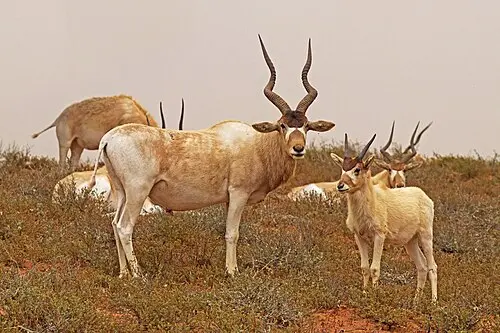
 📸 Photo
Photo: Charles J. Sharp · CC BY-SA 4.0 · Wikimedia Commons Source
Addax
Addax nasomaculatus (Addax · アダックス)
💡 Everyday Comparisons for Size, Mass & Speed
- 💡 Local people use addax hides to make shoes and sandal soles (Animal Diversity Web).
- 💡 The Smithsonian's National Zoo notes that the addax also licks morning dew off leaves.
- 💡 A weight of 125 kg is just over six 20 kg bags of rice (Comparison).
Reference standards: coach bus ~12 m, mid-size car ~4.9 m, compact car ~1 t, basketball hoop 3.05 m, credit card 8.56 cm.
Site-computed relative index from recorded values; not a formal scientific metric.
📖 1. Overview
The addax is the most desert-adapted antelope living in the Sahara Desert, spending almost its entire life without drinking water.
🦴 2. Anatomy & Morphology
Its summer coat ranges from sandy to nearly white, darkening to grayish brown in winter. Both males and females have horns averaging 72 cm in length with 1.5–3 spiral twists, and widely splayed hooves well suited for walking on sand.
🔍 3. Ecology & Behavior
It feeds on desert grasses and shrubs, obtaining the moisture it needs from its food. It travels in herds of 5–20 individuals and cannot run fast because of its short legs.
🇰🇷 4. Connection to Korea
No direct record connecting this species to Korea has been found.
📚 Sources & References
- • IUCN Red List CR (2016) — https://www.iucnredlist.org/species/512/50180603
- • IUCN Red List category CR — latest assessment at iucnredlist.org
- • mammaldiversity.org — 1006233
- • iucnredlist.org — 50180603
- • wikidata.org — Q190154
- • commons.wikimedia.org — File:Addax (Addax nasomaculatus) adult male and juvenile.jpg
- • animaldiversity.org — Addax nasomaculatus
- • nationalzoo.si.edu — addax
- • Silhouette: PhyloPic — Andy Wilson · CC0 1.0
Recorded dimensions are widely cited representative estimates from public literature and may vary by study or specimen.