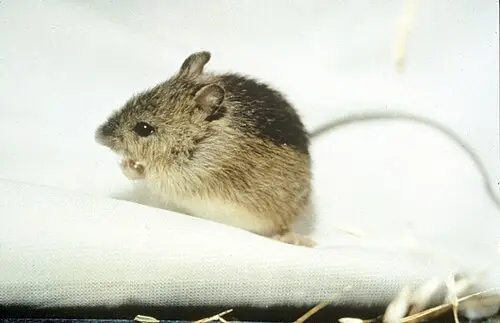
 📸 Photo
Photo: U.S. Fish and Wildlife Service · Public domain · Wikimedia Commons Source
Northern Meadow Jumping Mouse
Zapus hudsonius (Northern Meadow Jumping Mouse · Northern Meadow Jumping Mouse)
💡 Everyday Comparisons for Size, Mass & Speed
- 💡 Its maximum weight of 30 g is about four Korean 500-won coins (about 7.7 g each), and its total length of 24 cm is slightly longer than the short side of a sheet of A4 paper (21 cm) (Comparison).
- 💡 Before hibernation its weight increases to 35 g or more, and it builds its hibernation nest 0.3–0.9 m underground (Animal Diversity Web).
Reference standards: coach bus ~12 m, mid-size car ~4.9 m, compact car ~1 t, basketball hoop 3.05 m, credit card 8.56 cm.
Site-computed relative index from recorded values; not a formal scientific metric.
📖 1. Overview
The Northern Meadow Jumping Mouse is a small mouse living in moist grasslands of North America with a very long tail and hind feet.
🦴 2. Anatomy & Morphology
Its body is small and slender with an extremely long tail and long hind feet. It has a dark or olive band along its back, and unlike woodland jumping mice its tail tip is not white.
🔍 3. Ecology & Behavior
It eats mainly seeds along with berries and insects, feeding heavily on moth larvae and beetles in spring. It usually moves in short hops of 2.5–15 cm, swims and digs well, and enters hibernation from late September to early October (months 9–10).
🇰🇷 4. Connection to Korea
No direct record connecting this species to Korea has been found.
📚 Sources & References
- • IUCN Red List LC (2016) — https://www.iucnredlist.org/species/42613/115194664
- • IUCN Red List category LC — latest assessment at iucnredlist.org
- • mammaldiversity.org — 1002014
- • iucnredlist.org — 115194664
- • wikidata.org — Q1761993
- • commons.wikimedia.org — File:Zapus hudsonius.jpg
- • animaldiversity.org — Zapus hudsonius
- • Silhouette: PhyloPic — author not recorded · CC0 1.0
Recorded dimensions are widely cited representative estimates from public literature and may vary by study or specimen.