 📸 Photo
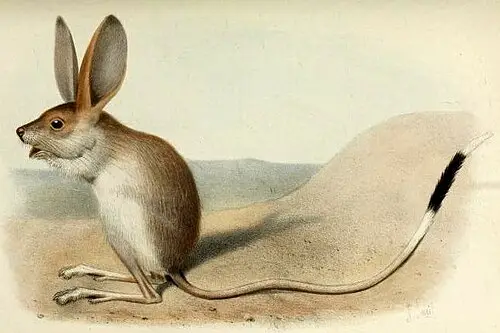
Photo: Joseph Smit (1836–1929) · Public domain · Wikimedia Commons Source
Long-eared Jerboa
Euchoreutes naso (Long-eared Jerboa · Long-eared Jerboa)
💡 Everyday Comparisons for Size, Mass & Speed
- 💡 Its maximum head-and-body length of 9 cm is similar to the long side of a credit card (about 8.6 cm), and its 150–162 mm tail is about 1.8 times its body length (Comparison).
- 💡 Its ears are 1/3 longer than its head, and it hunts flying insects by sound (Animal Diversity Web).
Reference standards: coach bus ~12 m, mid-size car ~4.9 m, compact car ~1 t, basketball hoop 3.05 m, credit card 8.56 cm.
📖 1. Overview
The Long-eared Jerboa is a small rodent that hops through sandy valleys of arid deserts, distinguished by ears much longer than its head.
🦴 2. Anatomy & Morphology
Its ears are about 1/3 longer than its head, and the tip of its tail has a black-and-white tuft. Its long hind feet measure 40–46 mm and have hairy soles for running across sand.
🔍 3. Ecology & Behavior
Presumed to be nocturnal, it locates flying insects by sound and leaps swiftly into the air to catch them. It is thought to hibernate in winter, and its breeding habits are inferred only from closely related species as little is known about this species itself.
🇰🇷 4. Connection to Korea
No direct record connecting this species to Korea has been found.
📚 Sources & References
- • IUCN Red List LC (2016) — https://www.iucnredlist.org/species/8162/115087272
- • IUCN Red List category LC — latest assessment at iucnredlist.org
- • mammaldiversity.org — 1001996
- • iucnredlist.org — 115087272
- • wikidata.org — Q912425
- • commons.wikimedia.org — File:Euchoreutes naso.jpg
- • animaldiversity.org — Euchoreutes naso
- • Silhouette: PhyloPic — Margot Michaud · CC0 1.0 (Related taxon silhouette — Dipus sagitta)
Recorded dimensions are widely cited representative estimates from public literature and may vary by study or specimen.