 📸 Photo
Photo: Benny Trapp · CC BY 3.0 · Wikimedia Commons Source
Adder
Vipera berus (Adder · ヨーロッパクサリヘビ)
💡 Everyday Comparisons for Size, Mass & Speed
- 💡 An average length of 60 cm is the length of two 30 cm rulers placed end to end (Comparison). A male's weight of 50–70 g is about the weight of a chicken egg (about 60 g) (Comparison).
- 💡 Animal Diversity Web notes that it controls numbers of small animals such as rodents, and its extracted venom is used to make antivenom for treating bites from this snake.
Reference standards: coach bus ~12 m, mid-size car ~4.9 m, compact car ~1 t, basketball hoop 3.05 m, credit card 8.56 cm.
Site-computed relative index from recorded values; not a formal scientific metric.
📖 1. Overview
The Adder (European Adder) is a small viper distributed from northwestern Europe through Siberia to Hamgyeong-do in Korea, surviving even in cold northern grasslands.
🦴 2. Anatomy & Morphology
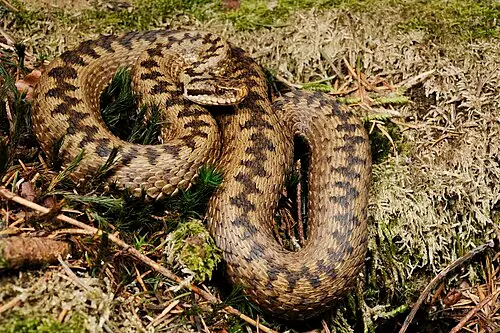
It has a dark brown zigzag stripe down its greenish-brown or dark brown back and a dark 'V'-shaped marking on its head. The National List of Species of Korea notes that unlike the Short-tailed Mamushi, it lacks heat-sensing pit organs.
🔍 3. Ecology & Behavior
It eats voles, shrews, mice, small lizards, birds, and frogs, hunting either by ambush or by active searching. It mates in month 4 and enters hibernation in months 9–10, with up to 100 individuals gathering at a single overwintering site.
🇰🇷 4. Connection to Korea
It is listed as 'Buksalmosa (Korean name)' in the National List of Species of Korea, and is recorded as distributed in the Hamgyeong-do region of Korea.
📚 Sources & References
- • IUCN Red List LC (2021) — https://www.iucnredlist.org/species/47756146/743903
- • IUCN Red List category LC — latest assessment at iucnredlist.org
- • catalogueoflife.org — 5BJ7Y
- • iucnredlist.org — 743903
- • 국가생물종목록(국립생물자원관) ktsn 120000059508 — https://species.nibr.go.kr/home/mainHome.do?cont_link=009&subMenu=009002&contCd=009002&ktsn=120000059508
- • wikidata.org — Q192056
- • commons.wikimedia.org — File:Benny Trapp Vipera berus.jpg
- • animaldiversity.org — Vipera berus
- • species.nibr.go.kr — mainHome.do
- • Silhouette: PhyloPic — Beth Reinke · CC0 1.0
Recorded dimensions are widely cited representative estimates from public literature and may vary by study or specimen.