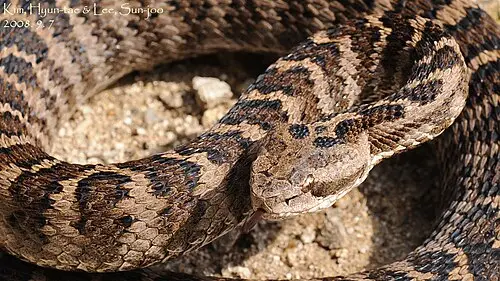
 📸 Photo
Photo: Kim, Hyun-tae · CC BY 4.0 · Wikimedia Commons Source
Central Asian Pitviper
Gloydius intermedius (Central Asian Pitviper · Central Asian Pitviper)
💡 Everyday Comparisons for Size, Mass & Speed
- 💡 A total length of 80 cm is similar to that of a baseball bat (about 84 cm) (Comparison).
- 💡 Because it lives only high in the mountains, a study notes that it appears less frequently in Korean snakebite reports than the Ussuri Mamushi or the Short-tailed Mamushi.
Reference standards: coach bus ~12 m, mid-size car ~4.9 m, compact car ~1 t, basketball hoop 3.05 m, credit card 8.56 cm.
📖 1. Overview
The Central Asian Pitviper is a venomous snake living in mountains of northern China, the Russian Far East, and the Korean Peninsula; in Korea it is seen only at higher mountain elevations.
🦴 2. Anatomy & Morphology
A venomous snake in the viper family, it is ovoviviparous, giving birth to live young rather than laying eggs. Its total length can exceed 80 cm.
🔍 3. Ecology & Behavior
Korean studies note that because it lives in mountains above 500 m elevation, it rarely comes into contact with people, and snakebite reports involving it are relatively uncommon. Reliable sources describing its diet have not yet been found.
🇰🇷 4. Connection to Korea
It is listed in the National List of Species of Korea as "Kkachisalmosa" (Korean name) under the scientific name Gloydius saxatilis (which the Reptile Database treats as synonymous with G. intermedius), and is distributed mainly in northeastern mountain regions such as Gangwon-do, Gyeonggi-do, and Gyeongsangbuk-do.
📚 Sources & References
- • IUCN Red List LC (2021) — https://www.iucnredlist.org/species/164696/1068703
- • IUCN Red List category LC — latest assessment at iucnredlist.org
- • catalogueoflife.org — 6KLC7
- • iucnredlist.org — 1068703
- • 국가생물종목록(국립생물자원관) ktsn 120000059505 — https://species.nibr.go.kr/home/mainHome.do?cont_link=009&subMenu=009002&contCd=009002&ktsn=120000059505
- • wikidata.org — Q2705186
- • commons.wikimedia.org — File:Gloydius intermedius.jpg
- • reptile-database.reptarium.cz — species
- • pmc.ncbi.nlm.nih.gov — PMC9415592
- • pmc.ncbi.nlm.nih.gov — PMC9436999
- • species.nibr.go.kr — general-search
- • Silhouette: PhyloPic — Beth Reinke · CC0 1.0 (Related taxon silhouette — Vipera berus)
Recorded dimensions are widely cited representative estimates from public literature and may vary by study or specimen.