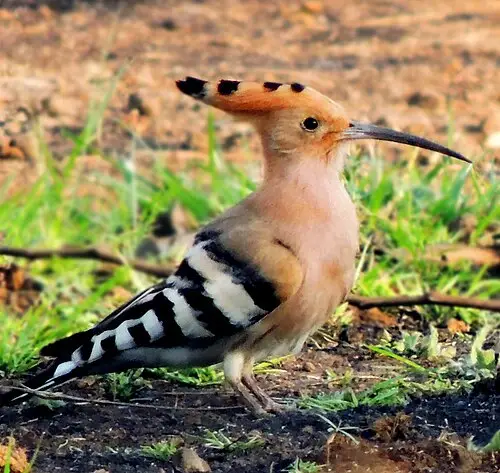
 📸 Photo
Photo: Shantanu Kuveskar · CC BY-SA 3.0 · Wikimedia Commons Source
Common Hoopoe
Upupa epops (Common Hoopoe · ヤツガシラ)
💡 Everyday Comparisons for Size, Mass & Speed
- 💡 Its body length of 28 cm is slightly shorter than the long side of an A4 sheet of paper (29.7 cm) (Comparison).
- 💡 Because it lives in old tree hollows on hills and farmlands and forages mainly on the ground, it can be seen in rural fields of central and northern Korea.
Reference standards: coach bus ~12 m, mid-size car ~4.9 m, compact car ~1 t, basketball hoop 3.05 m, credit card 8.56 cm.
📖 1. Overview
The Common Hoopoe is a bird with long crest feathers on its head that fan open, distributed across Africa and Eurasia; in Korea it is an uncommon summer visitor living in central and northern regions.
🦴 2. Anatomy & Morphology
The long feathers on its crown form a striking crest that can be raised and closed, with black tips and a white band behind them. Its body is pinkish-brown, its lower back and upper rump are barred with creamy white and blackish-brown, and its uppertail coverts are black.
🔍 3. Ecology & Behavior
It favors insect larvae and also eats spiders and earthworms, living mainly on the ground alone or in pairs. It lays 5–8 eggs between April and June.
🇰🇷 4. Connection to Korea
In the National List of Species of Korea, it is listed as an uncommon summer visitor in Korea inhabiting central and northern regions.
📚 Sources & References
- • IUCN Red List LC (2020) — https://www.iucnredlist.org/species/22682655/181836360
- • IUCN Red List category LC — latest assessment at iucnredlist.org
- • doi.org — avilist.v2026
- • iucnredlist.org — 181836360
- • 국가생물종목록(국립생물자원관) ktsn 120000001899 — https://species.nibr.go.kr/home/mainHome.do?cont_link=009&subMenu=009002&contCd=009002&ktsn=120000001899
- • wikidata.org — Q25247
- • commons.wikimedia.org — File:Common Hoopoe Photograph By Shantanu Kuveskar.jpg
- • species.nibr.go.kr — mainHome.do
- • Silhouette: PhyloPic — Ferran Sayol · CC0 1.0
Recorded dimensions are widely cited representative estimates from public literature and may vary by study or specimen.