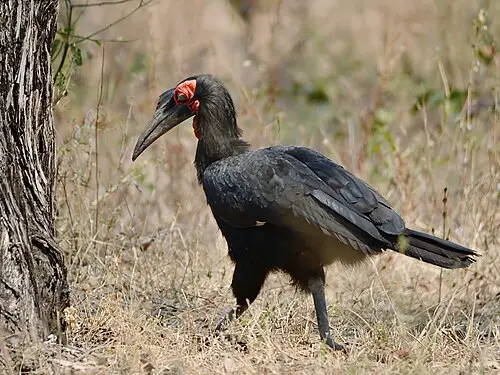
 📸 Photo
Photo: Hans Hillewaert · CC BY-SA 3.0 · Wikimedia Commons Source
Southern Ground Hornbill
Bucorvus leadbeateri (Southern Ground Hornbill · ミナミジサイチョウ)
💡 Everyday Comparisons for Size, Mass & Speed
- 💡 Its mass of 4.2 kg is just under half of a 10 kg bag of rice, and its length of 1 m is about three and a half sheets of A4 paper laid end to end along the long side (29.7 cm) (Comparison).
- 💡 Because it is commonly kept in zoos and wildlife sanctuaries, visitors to zoos have a good chance of seeing one.
Reference standards: coach bus ~12 m, mid-size car ~4.9 m, compact car ~1 t, basketball hoop 3.05 m, credit card 8.56 cm.
Site-computed relative index from recorded values; not a formal scientific metric.
📖 1. Overview
The southern ground hornbill is the largest bird in the hornbill family, spending its time walking in groups on the ground rather than in the sky. Its IUCN status is Vulnerable (VU).
🦴 2. Anatomy & Morphology
Its plumage is entirely black except for white primary wing feathers. Males have continuous red skin across the face and throat, while females have a blue patch on the throat.
🔍 3. Ecology & Behavior
It eats frogs, small mammals, reptiles, and insects—with insects being its most important food—and swallows prey whole with its large bill. It lives in groups of 2–11 birds where only the dominant male and female breed while the others work to find food, and a group's territory averages about 100 km².
🇰🇷 4. Connection to Korea
No direct record connecting this species to Korea has been found.
📚 Sources & References
- • IUCN Red List VU (2025) — https://www.iucnredlist.org/species/22682638/266675349
- • IUCN Red List category VU — latest assessment at iucnredlist.org
- • doi.org — avilist.v2026
- • iucnredlist.org — 266675349
- • wikidata.org — Q685074
- • commons.wikimedia.org — File:Bucorvus leadbeateri (Mfuwe).jpg
- • animaldiversity.org — Bucorvus leadbeateri
- • Silhouette: PhyloPic — author not recorded · CC0 1.0
Recorded dimensions are widely cited representative estimates from public literature and may vary by study or specimen.