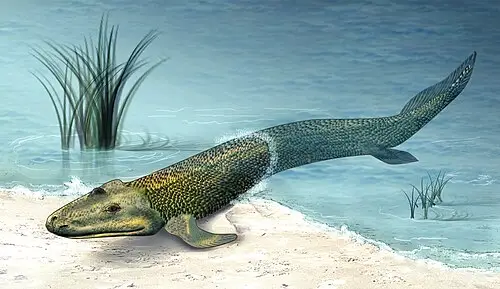
 🎨 Restoration
Restoration: Zina Deretsky , National Science Foundation · Public domain · Wikimedia Commons Source
Life restorations are artistic reconstructions based on fossil evidence; true coloration and soft-tissue details remain uncertain.
Tiktaalik
Tiktaalik roseae (Tiktaalik · Tiktaalik)
Known only from fossils. The IUCN Red List assesses only species extant since 1500 CE, so fossil taxa are not assigned a category.
💡 Everyday Comparisons for Size, Mass & Speed
- 💡 Its maximum specimen length of about 2.7 m is longer than a single bed (about 2 m) (Comparison).
- 💡 Watching a mudskipper crawl across tidal flats on its fins helps imagine how Tiktaalik propped up its body in shallow water (Comparison; not a close relative).
Reference standards: coach bus ~12 m, mid-size car ~4.9 m, compact car ~1 t, basketball hoop 3.05 m, credit card 8.56 cm.
📖 1. Overview
Tiktaalik roseae (genus Tiktaalik) was a lobe-finned fish that lived during the Late Devonian about 375 million years ago, famous as a 'fishapod' bridging finned fish and four-legged tetrapods. It was discovered on Ellesmere Island in the Canadian Arctic and announced in 2006.
🦴 2. Anatomy & Morphology
It had a crocodile-like head, sharp teeth, and a flattened body. Tetrapod-like features such as a mobile neck, ribs, and a wrist-like joint appear alongside the scales and fin rays of a finned fish.
🔍 3. Fossil Record & Paleoecology
CT studies showed that it was an intermediate form capable of biting with a sturdy skull while still retaining structures for suction feeding. It is interpreted as having lived in shallow watersides and water's-edge environments.
🇰🇷 4. Connection to Korea
No direct record connecting this species to Korea has been found.
📚 Sources & References
- • Fossil taxon — the IUCN Red List assesses only species living or extinct since 1500
- • paleobiodb.org — basicTaxonInfo
- • wikidata.org — Q15709806
- • commons.wikimedia.org — File:Tiktaalik Chicago.JPG
- • chronicle.uchicago.edu — fossils.shtml
- • nature.com — nature04639
- • pmc.ncbi.nlm.nih.gov — PMC7896305
- • Silhouette: PhyloPic — author not recorded · CC0 1.0
Recorded dimensions are widely cited representative estimates from public literature and may vary by study or specimen.