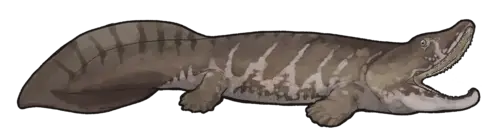
 🎨 Restoration
Restoration: SeismicShrimp · CC BY 4.0 · Wikimedia Commons Source
Life restorations are artistic reconstructions based on fossil evidence; true coloration and soft-tissue details remain uncertain.
Acanthostega
Acanthostega gunnari (Acanthostega · Acanthostega)
Known only from fossils. The IUCN Red List assesses only species extant since 1500 CE, so fossil taxa are not assigned a category.
💡 Everyday Comparisons for Size, Mass & Speed
- 💡 Because its forelimbs had eight digits, it had three more digits than a five-fingered human hand (Comparison).
- 💡 As a fossil that shows how limbs with digits arose, it appears whenever the origin of tetrapods (tetra = four, pod = foot) is discussed.
Reference standards: coach bus ~12 m, mid-size car ~4.9 m, compact car ~1 t, basketball hoop 3.05 m, credit card 8.56 cm.
📖 1. Overview
Acanthostega gunnari is one of the most primitive tetrapods, living in East Greenland during the Late Devonian (Famennian) about 3 hundred and 60 million years ago. It is thought to have lived almost entirely in the water.
🦴 2. Anatomy & Morphology
Its paddle-like limbs had eight digits on each hand and foot, and it had ossified gill bars indicating that it used internal gills. It also had a deep tail supported by fin rays.
🔍 3. Fossil Record & Paleoecology
Most fossils came from sandbars in ancient river channels and are interpreted as having been buried all at once by floods. Features such as its limb joints, tail fin, and gill bars point to an aquatic lifestyle.
🇰🇷 4. Connection to Korea
No direct record connecting this species to Korea has been found.
📚 Sources & References
- • Fossil taxon — the IUCN Red List assesses only species living or extinct since 1500
- • paleobiodb.org — basicTaxonInfo
- • wikidata.org — Q85409646
- • commons.wikimedia.org — File:Acanthostega Deep Time.jpg
- • tolweb.org — 15016
- • Silhouette: PhyloPic — author not recorded · CC0 1.0
Recorded dimensions are widely cited representative estimates from public literature and may vary by study or specimen.