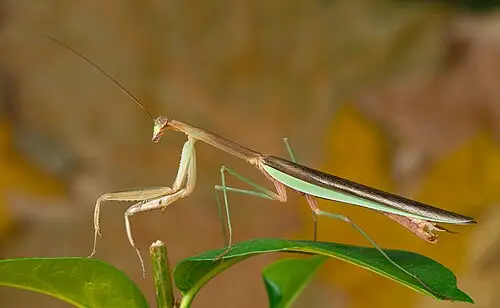
 📸 Photo
Photo: Luc Viatour · CC BY-SA 3.0 · Wikimedia Commons Source
Chinese mantis
Tenodera sinensis (Chinese mantis · Chinese mantis)
Not Evaluated (NE) on the IUCN Red List yet.
💡 Everyday Comparisons for Size, Mass & Speed
- 💡 Its body length of 95 mm is slightly longer than the long side of a credit card (85.6 mm) (Comparison).
- 💡 It can be seen in grassy areas of fields and forest edges from July to October and makes large egg cases on tree branches (National List of Species of Korea).
Reference standards: coach bus ~12 m, mid-size car ~4.9 m, compact car ~1 t, basketball hoop 3.05 m, credit card 8.56 cm.
📖 1. Overview
The Chinese mantis is a large green or brown mantis that lives in grassy areas of fields and forest edges, preying on other insects.
🦴 2. Anatomy & Morphology
Its body length is 70–95 mm, and females are larger than males. It closely resembles the narrow-winged mantis, but can be distinguished by the purplish-brown markings near the base when its hindwings are spread.
🔍 3. Ecology & Behavior
It catches and eats other insects such as grasshoppers, butterflies, bees, and true bugs. Adults appear from July to October and build large egg cases on tree branches.
🇰🇷 4. Connection to Korea
According to the National List of Species of Korea, it lives throughout Korea and is also distributed in Japan, China, and Southeast Asia.
📚 Sources & References
- • IUCN Red List: not evaluated (NE) — cross-checked with the Wikidata conservation-status entry
- • catalogueoflife.org — 55B2J
- • 국가생물종목록(국립생물자원관) ktsn 120000020913 — https://species.nibr.go.kr/home/mainHome.do?cont_link=009&subMenu=009002&contCd=009002&ktsn=120000020913
- • wikidata.org — Q1149167
- • commons.wikimedia.org — File:Tenodera sinensis 5 Luc Viatour.jpg
- • species.nibr.go.kr — mainHome.do
- • Silhouette: PhyloPic — Andy Wilson · CC0 1.0
Recorded dimensions are widely cited representative estimates from public literature and may vary by study or specimen.