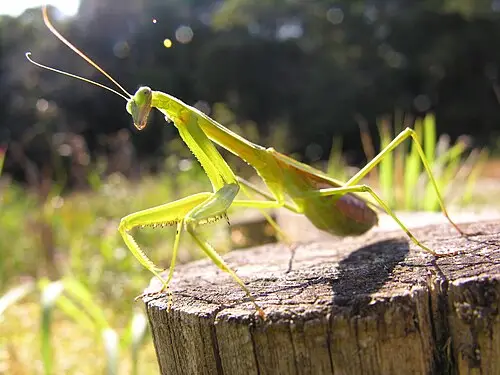
 📸 Photo
Photo: Yasunori Koide · CC BY-SA 3.0 · Wikimedia Commons Source
Narrow-winged mantis
Tenodera angustipennis (Narrow-winged mantis · チョウセンカマキリ)
Not Evaluated (NE) on the IUCN Red List yet.
💡 Everyday Comparisons for Size, Mass & Speed
- 💡 A female's maximum length of 86.6 mm is almost equal to the long side of a credit card (85.6 mm) (Comparison).
- 💡 Egg cases attached to trees and shrubs remain through winter, so they can be spotted on bare branches after leaves fall.
- 💡 When telling mantises apart in the field, look for this species' slimmer body than the Chinese mantis and the orange coloration between the bases of its forelegs.
Reference standards: coach bus ~12 m, mid-size car ~4.9 m, compact car ~1 t, basketball hoop 3.05 m, credit card 8.56 cm.
📖 1. Overview
The narrow-winged mantis (Tenodera angustipennis) is a large mantis common throughout the Korean Peninsula, where adults and egg cases are frequently found on trees and shrubs. Mantises are predatory insects that catch and eat other insects.
🦴 2. Anatomy & Morphology
Total body length is 44–63 mm in males and 51–87 mm in females, with a large, slender build. The body and forewings are green, yellowish-green, or brown, and it has sickle-shaped forelegs for catching prey.
🔍 3. Ecology & Behavior
It overwinters as eggs inside an egg case; 1st-instar nymphs hatch from late May to mid-June, and adults appear in mid-August. Mantises are generally carnivorous.
🇰🇷 4. Connection to Korea
It is distributed throughout the Korean Peninsula and is one of 8 mantis species confirmed in Korea. It is distinguished from the Chinese mantis by its more slender body and an orange spot between the bases of its forelegs.
📚 Sources & References
- • IUCN Red List: not evaluated (NE) — cross-checked with the Wikidata conservation-status entry
- • catalogueoflife.org — 7C2GR
- • 국가생물종목록(국립생물자원관) ktsn 120000020912 — https://species.nibr.go.kr/home/mainHome.do?cont_link=009&subMenu=009002&contCd=009002&ktsn=120000020912
- • wikidata.org — Q854184
- • commons.wikimedia.org — File:Tenodera angustipennis Saussure(Pregnant) DSCN9575.jpg
- • zookeys.pensoft.net — xml
- • Silhouette: PhyloPic — Andy Wilson · CC0 1.0 (Congeneric silhouette — Tenodera sinensis)
Recorded dimensions are widely cited representative estimates from public literature and may vary by study or specimen.