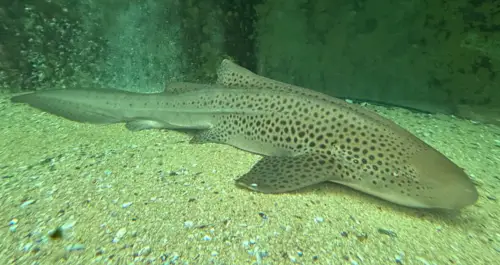
 📸 Photo
Photo: Felix Frost-Savage · CC BY-SA 4.0 · Wikimedia Commons Source
Zebra shark
Stegostoma tigrinum (Zebra shark · Zebra shark)
💡 Everyday Comparisons for Size, Mass & Speed
- 💡 Its maximum body length of 3.54 m is about three-quarters the length of a passenger car (about 4.5 m) (Comparison).
- 💡 A newborn pup of 20–26 cm is similar to the short side of an A4 sheet of paper (21 cm) (Comparison).
Reference standards: coach bus ~12 m, mid-size car ~4.9 m, compact car ~1 t, basketball hoop 3.05 m, credit card 8.56 cm.
📖 1. Overview
The zebra shark is a warm-water bottom-dwelling shark widely distributed from the Red Sea and East Africa to New Caledonia and Fiji, and north to southern Japan. It is assessed as Endangered (EN, 2024) on the IUCN Red List.
🦴 2. Anatomy & Morphology
It grows up to 3.54 m, and newborn pups measure 20–26 cm. Its egg cases are large, dark brown or purplish-black, and marked with longitudinal stripes.
🔍 3. Ecology & Behavior
It mainly eats mollusks such as bivalves, as well as small bony fish, crabs, shrimp, and sea snakes, and appears to be active at night. It is oviparous (egg-laying).
🇰🇷 4. Connection to Korea
No direct record connecting this species to Korea has been found.
📚 Sources & References
- • IUCN Red List EN (2024) — https://www.iucnredlist.org/species/41878
- • IUCN Red List category EN — latest assessment at iucnredlist.org
- • catalogueoflife.org — 4ZP9Z
- • iucnredlist.org — 41878
- • wikidata.org — Q107055371
- • commons.wikimedia.org — File:Zebra Shark at Sydney Sea Life Aquarium.png
- • fishbase.se — Stegostoma-tigrinum.html
- • Silhouette: PhyloPic — author not recorded · Public Domain Mark 1.0
Recorded dimensions are widely cited representative estimates from public literature and may vary by study or specimen.