 📸 Photo
Photo: Public domain · Public domain · Wikimedia Commons Source
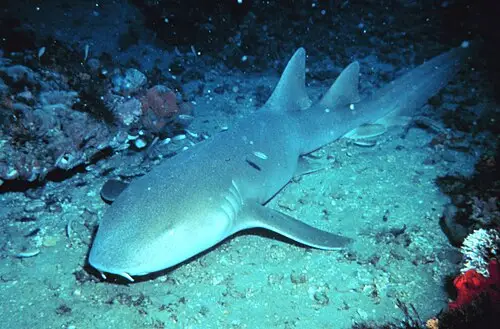
Nurse shark
Ginglymostoma cirratum (Nurse shark · コモリザメ)
💡 Everyday Comparisons for Size, Mass & Speed
- 💡 Its average length of 193 cm in ADW is similar to the height of a tall adult human (Comparison).
- 💡 It is traded for private aquariums and in the ornamental fish market, and is relatively docile in captivity. Its hide is used for leather, and it is also a subject of ecotourism (Animal Diversity Web).
- 💡 It is a species that can be seen in public aquariums (FishBase).
Reference standards: coach bus ~12 m, mid-size car ~4.9 m, compact car ~1 t, basketball hoop 3.05 m, credit card 8.56 cm.
Site-computed relative index from recorded values; not a formal scientific metric.
📖 1. Overview
The Nurse shark is a sluggish bottom shark that spends the day resting in coral reef crevices or on the sea floor and searches for food at night. It tends to stay in one area for a long time.
🦴 2. Anatomy & Morphology
Its body is yellow to grayish-brown and it has five gill openings. It is 27–30 cm long at birth and grows to 107–300 cm as an adult. Its body is well adapted to sucking in prey within 3 cm of its mouth.
🔍 3. Ecology & Behavior
At night, it forages along the bottom or ambushes prey, eating small fishes, cephalopods, snails and bivalves, sea urchins, and shrimps and crabs. It is ovoviviparous, giving birth to 21–28 young in a litter.
🇰🇷 4. Connection to Korea
No direct record connecting this species to Korea has been found.
📚 Sources & References
- • IUCN Red List VU (2021) — https://www.iucnredlist.org/species/144141186/3095153
- • IUCN Red List category VU — latest assessment at iucnredlist.org
- • catalogueoflife.org — 6KFCS
- • iucnredlist.org — 3095153
- • wikidata.org — Q756859
- • commons.wikimedia.org — File:Nurse shark.jpg
- • fishbase.se — Ginglymostoma-cirratum.html
- • animaldiversity.org — Ginglymostoma cirratum
- • Silhouette: PhyloPic — based on photo by fokitochikito (https://www.inaturalist.org/observations/220751543) · CC BY 4.0
Recorded dimensions are widely cited representative estimates from public literature and may vary by study or specimen.