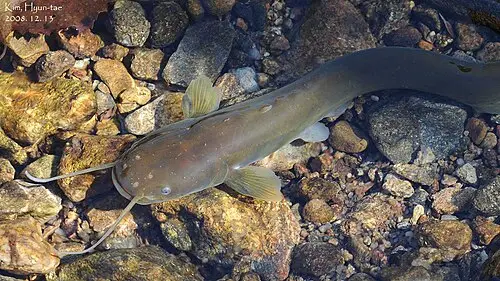
 📸 Photo
Photo: Kim, Hyun-tae · CC BY 4.0 · Wikimedia Commons Source
Korean slender catfish
Silurus microdorsalis (Korean slender catfish · Korean slender catfish)
💡 Everyday Comparisons for Size, Mass & Speed
- 💡 Its maximum total length of 35 cm is 5 cm longer than a 30 cm ruler (Comparison).
- 💡 It can be seen in clear mountain streams in the upper reaches of almost every major river in Korea (National List of Species of Korea).
- 💡 It resembles the Amur catfish but is distinguished by living in mountain streams and having a much smaller dorsal fin (National List of Species of Korea).
Reference standards: coach bus ~12 m, mid-size car ~4.9 m, compact car ~1 t, basketball hoop 3.05 m, credit card 8.56 cm.
📖 1. Overview
The Korean slender catfish is a catfish species endemic to Korea, living in clear, rocky mountain streams and the middle to upper reaches of rivers. Its body is more slender and elongated than the Amur catfish, and its dorsal fin is smaller.
🦴 2. Anatomy & Morphology
Its head is flattened from top to bottom and broad, while its body is cylindrical. Viewed from above, the tip of the snout forms a straight line and the lower jaw protrudes; the back is dark bluish-brown and the belly is yellowish-white.
🔍 3. Ecology & Behavior
It is a carnivore that feeds on aquatic insects and small fish. Its spawning season is from April to June, and its eggs are pale yellow.
🇰🇷 4. Connection to Korea
It is a Korean endemic species on the National List of Species of Korea, inhabiting almost all freshwater systems in Korea, including the Han, Geum, Yeongsan, Seomjin, and Nakdong Rivers.
📚 Sources & References
- • IUCN Red List LC (2025) — https://www.iucnredlist.org/species/197523559/214530057
- • IUCN Red List category LC — latest assessment at iucnredlist.org
- • catalogueoflife.org — 6YPTS
- • iucnredlist.org — 214530057
- • 국가생물종목록(국립생물자원관) ktsn 120000057688 — https://species.nibr.go.kr/home/mainHome.do?cont_link=009&subMenu=009002&contCd=009002&ktsn=120000057688
- • wikidata.org — Q3756939
- • commons.wikimedia.org — File:Silurus microdorsalis.jpg
- • fishbase.se — Silurus-microdorsalis.html
- • species.nibr.go.kr — mainHome.do
- • Silhouette: PhyloPic — Carlos Cano-Barbacil · CC0 1.0 (Congeneric silhouette — Silurus glanis)
Recorded dimensions are widely cited representative estimates from public literature and may vary by study or specimen.