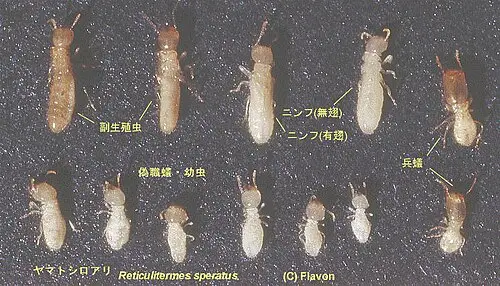
 📸 Photo
Photo: No machine-readable author provided. Flavon assumed (based on copyright claims). · CC BY-SA 2.5 · Wikimedia Commons Source
Japanese termite
Reticulitermes speratus (Japanese termite · ヤマトシロアリ)
Not Evaluated (NE) on the IUCN Red List yet.
💡 Everyday Comparisons for Size, Mass & Speed
- 💡 The chambers of its wooden nest are linked by tiny passages; young soldiers guard near the king and queen's chamber, while older soldiers guard the outer perimeter near nest entrances (Frontiers review).
- 💡 Research shows that workers use lysozyme and β-glucosidase enzymes on the eggs as signals to recognize and pile eggs together (Frontiers review).
Reference standards: coach bus ~12 m, mid-size car ~4.9 m, compact car ~1 t, basketball hoop 3.05 m, credit card 8.56 cm.
📖 1. Overview
The Japanese termite is a social insect divided into workers, soldiers, and reproductives that lives in colonies inside wooden nests.
🦴 2. Anatomy & Morphology
Soldiers secrete a substance called (−)-β-elemene from their bodies, which inhibits workers from differentiating into soldiers and also suppresses fungi. Workers have an enzyme (β-glucosidase) in their salivary glands and hindgut that breaks down cellulose.
🔍 3. Ecology & Behavior
The nest is divided into multiple chambers connected by small passages, with the king and queen's chamber deep inside the wood. Workers release an odor substance (aggregation pheromone) at the nest site to gather nestmates.
🇰🇷 4. Connection to Korea
It is listed under the Korean name 'Huin-gae-mi' on the National List of Species of Korea (National Institute of Biological Resources (NIBR)).
📚 Sources & References
- • IUCN Red List: not evaluated (NE) — cross-checked with the Wikidata conservation-status entry
- • catalogueoflife.org — 794FV
- • 국가생물종목록(국립생물자원관) ktsn 120000020919 — https://species.nibr.go.kr/home/mainHome.do?cont_link=009&subMenu=009002&contCd=009002&ktsn=120000020919
- • wikidata.org — Q5977511
- • commons.wikimedia.org — File:Reticulitermes speratus 19790928 1.jpg
- • frontiersin.org — full
Recorded dimensions are widely cited representative estimates from public literature and may vary by study or specimen.