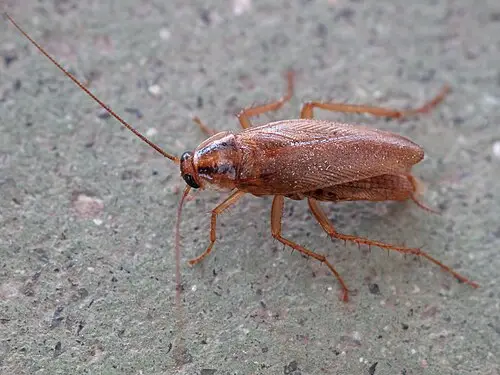
 📸 Photo
Photo: Lmbuga · CC BY-SA 3.0 · Wikimedia Commons Source
German cockroach
Blattella germanica (German cockroach · チャバネゴキブリ)
Not Evaluated (NE) on the IUCN Red List yet.
💡 Everyday Comparisons for Size, Mass & Speed
- 💡 Its body length of 15 mm is slightly smaller than the diameter of a 10-won coin (18 mm).
- 💡 It survives only in human dwellings, requiring water, food, and shelter, with cold being its greatest limiting factor (University of Florida UF/IFAS).
Reference standards: coach bus ~12 m, mid-size car ~4.9 m, compact car ~1 t, basketball hoop 3.05 m, credit card 8.56 cm.
Site-computed relative index from recorded values; not a formal scientific metric.
📖 1. Overview
The German cockroach (Blattella germanica) is a small cockroach that lives alongside humans worldwide and can hardly survive without them.
🦴 2. Anatomy & Morphology
Adults are brown to dark brown with two parallel stripes on the pronotum. Males are thin and slender, whereas females are stout with wings covering the entire abdomen.
🔍 3. Ecology & Behavior
It eats almost anything, from table crumbs and pet food to book bindings. The female carries the egg case at the tip of her abdomen until just before the nymphs hatch, and development from egg to adult takes about 100 days.
🇰🇷 4. Connection to Korea
It is listed under the Korean name 'Bakwi' in the National List of Species of Korea (National Institute of Biological Resources).
📚 Sources & References
- • IUCN Red List: not evaluated (NE) — cross-checked with the Wikidata conservation-status entry
- • catalogueoflife.org — 5WLVY
- • 국가생물종목록(국립생물자원관) ktsn 120000020893 — https://species.nibr.go.kr/home/mainHome.do?cont_link=009&subMenu=009002&contCd=009002&ktsn=120000020893
- • wikidata.org — Q466194
- • commons.wikimedia.org — File:Blattodea. Cascuda. Santiago de Compostela 1.jpg
- • ask.ifas.ufl.edu — IN128
- • animaldiversity.org — Blattella germanica
- • Silhouette: PhyloPic — author not recorded · CC0 1.0
Recorded dimensions are widely cited representative estimates from public literature and may vary by study or specimen.