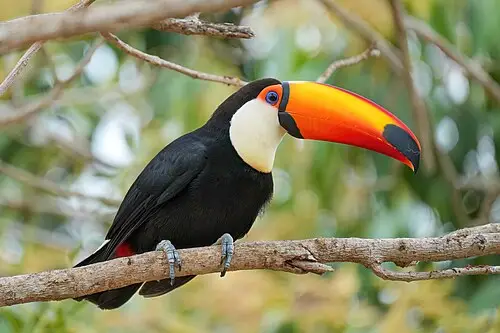
 📸 Photo
Photo: Giles Laurent · CC BY-SA 4.0 · Wikimedia Commons Source
Toco Toucan
Ramphastos toco (Toco Toucan · オニオオハシ)
💡 Everyday Comparisons for Size, Mass & Speed
- 💡 Its body length of 61 cm is similar to the length of two sheets of A4 paper along the long side (29.7 cm, about 59 cm total), and its bill is 1/3 of its body length, around 20 cm (Comparison).
- 💡 In South America there are sightseeing tours to watch this bird, many zoos exhibit it, and it is also traded as a pet.
Reference standards: coach bus ~12 m, mid-size car ~4.9 m, compact car ~1 t, basketball hoop 3.05 m, credit card 8.56 cm.
Site-computed relative index from recorded values; not a formal scientific metric.
📖 1. Overview
The Toco Toucan is the largest species in the toucan family and has the largest bill relative to body size of any bird. It lives in semi-open areas of South America.
🦴 2. Anatomy & Morphology
Its large yellowish-orange bill has a black patch at the tip and accounts for 1/20 of its body weight and 1/3 of its body length. What looks like a blue iris is actually a thin layer of skin around the eye, surrounded outside by orange skin.
🔍 3. Ecology & Behavior
In the forest canopy it eats mainly fruit, as well as insects and the eggs of other birds. Pairs court by tossing fruit back and forth, lay 2–4 eggs in a tree cavity in spring, and live as social birds in flocks of around 6.
🇰🇷 4. Connection to Korea
No direct record connecting this species to Korea has been found.
📚 Sources & References
- • IUCN Red List LC (2025) — https://www.iucnredlist.org/species/22682164/281011279
- • IUCN Red List category LC — latest assessment at iucnredlist.org
- • doi.org — avilist.v2026
- • iucnredlist.org — 281011279
- • wikidata.org — Q376038
- • commons.wikimedia.org — File:006 Toco toucan in Encontro das Águas State Park Photo
- • animaldiversity.org — Ramphastos toco
- • Silhouette: PhyloPic — Jun Mencius · CC0 1.0
Recorded dimensions are widely cited representative estimates from public literature and may vary by study or specimen.