 📸 Photo
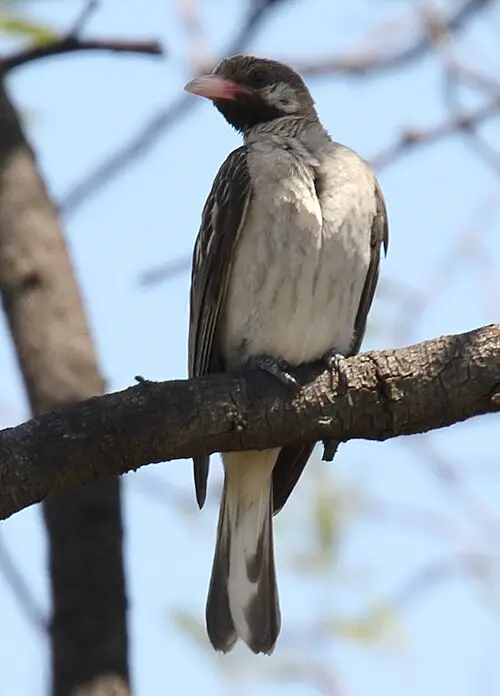
Photo: Dominic Sherony · CC BY-SA 2.0 · Wikimedia Commons Source
Greater Honeyguide
Indicator indicator (Greater Honeyguide · ノドグロミツオシエ)
💡 Everyday Comparisons for Size, Mass & Speed
- 💡 Its body length of 20 cm is similar to the short side of an A4 sheet of paper (21 cm), and its weight of about 49 g is lighter than a chicken egg (about 60 g) (Comparison).
- 💡 Because of its habit of leading others to beehives, it frequently appears in folktales and works of art.
Reference standards: coach bus ~12 m, mid-size car ~4.9 m, compact car ~1 t, basketball hoop 3.05 m, credit card 8.56 cm.
Site-computed relative index from recorded values; not a formal scientific metric.
📖 1. Overview
The Greater Honeyguide is the largest species in the honeyguide family, an African bird known for guiding humans and Honey Badgers to beehives.
🦴 2. Anatomy & Morphology
Males have a pink bill, a black throat, pale gray ear patches, and a nearly white breast with a small patch of golden feathers on the wing coverts. Females are grayish-brown overall without throat or cheek markings, and juveniles are yellow-gold and olive-brown.
🔍 3. Ecology & Behavior
Equipped with enzymes to digest beeswax, it feeds mainly on wax as well as hive larvae and insects. By calling and spreading its tail, it leads humans, Honey Badgers, and baboons to beehives, and practices brood parasitism by laying one egg per nest in the nests of other birds.
🇰🇷 4. Connection to Korea
No direct record connecting this species to Korea has been found.
📚 Sources & References
- • IUCN Red List LC (2024) — https://www.iucnredlist.org/species/22680616/263638394
- • IUCN Red List category LC — latest assessment at iucnredlist.org
- • doi.org — avilist.v2026
- • iucnredlist.org — 263638394
- • wikidata.org — Q593582
- • commons.wikimedia.org — File:Greater Honeyguide (Indicator indicator) (45663851145),
- • animaldiversity.org — Indicator indicator
Recorded dimensions are widely cited representative estimates from public literature and may vary by study or specimen.