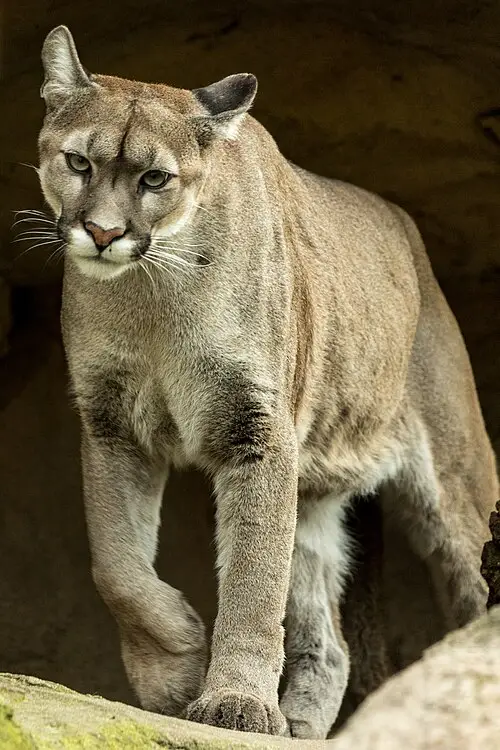
 📸 Photo
Photo: Carlos · CC BY 2.0 · Wikimedia Commons Source
Puma
Puma concolor (Puma · ピューマ)
💡 Everyday Comparisons for Size, Mass & Speed
- 💡 Its maximum weight of 120 kg equals 6 bags of 20 kg rice, and its length of about 1.5 m is similar to an adult's height (Comparison).
- 💡 As a top predator, it helps regulate populations of ungulates such as deer (Animal Diversity Web), while also being popular as a trophy animal and sometimes captured for zoos.
Reference standards: coach bus ~12 m, mid-size car ~4.9 m, compact car ~1 t, basketball hoop 3.05 m, credit card 8.56 cm.
Site-computed relative index from recorded values; not a formal scientific metric.
📖 1. Overview
The Puma is a large, slender felid widely distributed across the Americas. As long as prey and cover are available, it lives anywhere from mountains and forests to grasslands and swamps.
🦴 2. Anatomy & Morphology
Its fur is short and coarse, ranging from yellowish-brown to grayish-brown, with a paler belly and throat. Its tail is long, cylindrical, and black-tipped, and its broad feet have five toes on the forefeet and four on the hindfeet.
🔍 3. Ecology & Behavior
Ungulates such as elk and deer are its main prey, though it also eats smaller animals. It stalks quietly, leaps onto the prey's back from close range, and breaks its neck. It lives alone and is mainly active at night.
🇰🇷 4. Connection to Korea
No direct record connecting this species to Korea has been found.
📚 Sources & References
- • IUCN Red List LC (2015) — https://www.iucnredlist.org/species/18868/97216466
- • IUCN Red List category LC — latest assessment at iucnredlist.org
- • mammaldiversity.org — 1006017
- • iucnredlist.org — 97216466
- • wikidata.org — Q35255
- • commons.wikimedia.org — File:Puma - 49044464307.jpg
- • animaldiversity.org — Puma concolor
- • Silhouette: PhyloPic — An Ignorant Atheist · CC0 1.0
Recorded dimensions are widely cited representative estimates from public literature and may vary by study or specimen.