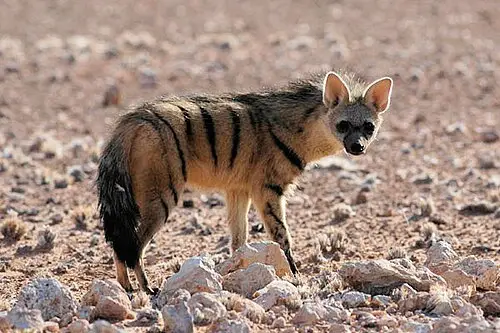
 📸 Photo
Photo: by Dkaeuferle = Dominik Käuferle · CC BY-SA 3.0 · Wikimedia Commons Source
Southern Aardwolf
Proteles cristatus (Southern Aardwolf · アードウルフ)
💡 Everyday Comparisons for Size, Mass & Speed
- 💡 Its total length of 1.05 m is slightly shorter than the height of a first-grade elementary school child (about 1.2 m) (Comparison).
- 💡 Its weight of 14 kg equals one and a half 10 kg bags of rice (Comparison).
- 💡 A single individual can eat up to 105 million termites a year, helping African farmers by reducing termites that consume pasture grass for livestock (Animal Diversity Web).
Reference standards: coach bus ~12 m, mid-size car ~4.9 m, compact car ~1 t, basketball hoop 3.05 m, credit card 8.56 cm.
Site-computed relative index from recorded values; not a formal scientific metric.
📖 1. Overview
The Southern Aardwolf belongs to the hyena family but is an African mammal that feeds almost exclusively on termites. Its range is split between northeastern and southern Africa.
🦴 2. Anatomy & Morphology
It has yellowish-brown to dark brown fur with black stripes and a mane running from the back of the head to the tail. Its ears are large and pointed, its skull is slender, and its cheek teeth are small because it eats only termites.
🔍 3. Ecology & Behavior
Licking up termites with its broad, sticky tongue, it can eat up to 300,000 in a single night. Active mainly at night alone or in pairs, it holds a territory of 1–4 km², breeds in June–July, and gives birth to 2–5 young after about 90 days of gestation.
🇰🇷 4. Connection to Korea
No direct record connecting this species to Korea has been found.
📚 Sources & References
- • IUCN Red List LC (2015) — https://www.iucnredlist.org/species/18372
- • IUCN Red List category LC — latest assessment at iucnredlist.org
- • mammaldiversity.org — 1006074
- • iucnredlist.org — 18372
- • wikidata.org — Q185295
- • commons.wikimedia.org — File:Proteles cristatus1.jpg
- • animaldiversity.org — Proteles cristata
- • Silhouette: PhyloPic — Margot Michaud · CC0 1.0
Recorded dimensions are widely cited representative estimates from public literature and may vary by study or specimen.