 📸 Photo
Photo: Bernard DUPONT from FRANCE · CC BY-SA 2.0 · Wikimedia Commons Source
Brown Hyena
Parahyaena brunnea (Brown Hyena · カッショクハイエナ)
💡 Everyday Comparisons for Size, Mass & Speed
- 💡 A body length of 160 cm is about the average height of an adult in Korea (Comparison).
- 💡 A weight of 72.6 kg is about the weight of an adult human (Comparison).
- 💡 Some pastoralists value the income and jobs brought by ecotourism, and Brown Hyenas help reduce the spread of parasites by cleaning up carcasses (ADW).
Reference standards: coach bus ~12 m, mid-size car ~4.9 m, compact car ~1 t, basketball hoop 3.05 m, credit card 8.56 cm.
Site-computed relative index from recorded values; not a formal scientific metric.
📖 1. Overview
The Brown Hyena is a hyena of southern African deserts and coasts and the second-largest member of the hyena family after the spotted hyena. Clan members raise cubs together.
🦴 2. Anatomy & Morphology
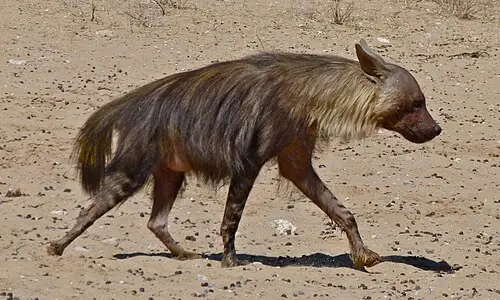
Its long, shaggy coat is dark brown to black on the body with tan shoulders and neck, and hair on the neck and back grows up to 30 cm long. Its forelegs are longer and sturdier than its hind legs, giving it an uphill stance, and its heavy teeth are built for crushing bones.
🔍 3. Ecology & Behavior
It feeds mainly on carcasses left by lions and leopards, and along the coast it eats black-backed jackals and fur seal pups, while getting moisture from watery fruits such as tsama melons in arid areas. Mothers nurse cubs of other females as well, and all clan members bring food to the den.
🇰🇷 4. Connection to Korea
No direct record connecting this species to Korea has been found.
📚 Sources & References
- • IUCN Red List NT (2015) — https://www.iucnredlist.org/species/10276/82344448
- • IUCN Red List category NT — latest assessment at iucnredlist.org
- • mammaldiversity.org — 1006073
- • iucnredlist.org — 82344448
- • wikidata.org — Q28157482
- • commons.wikimedia.org — File:Brown Hyena (Parahyaena brunnea) (6472940707).jpg
- • animaldiversity.org — Hyaena brunnea
- • Silhouette: PhyloPic — Margot Michaud · CC0 1.0
Recorded dimensions are widely cited representative estimates from public literature and may vary by study or specimen.