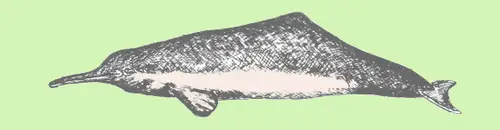
 📸 Photo
Photo: Dixi at Polish Wikipedia · Public domain · Wikimedia Commons Source
Franciscana
Pontoporia blainvillei (Franciscana · ラプラタカワイルカ)
💡 Everyday Comparisons for Size, Mass & Speed
- 💡 Its maximum body length of 1.71 m is almost the same as a 1.7 m tall adult (Comparison).
- 💡 Its average weight of 32 kg is about one and a half 20 kg bags of rice (Comparison).
Reference standards: coach bus ~12 m, mid-size car ~4.9 m, compact car ~1 t, basketball hoop 3.05 m, credit card 8.56 cm.
Site-computed relative index from recorded values; not a formal scientific metric.
📖 1. Overview
The Franciscana is a small dolphin living along the Atlantic coast of South America; despite its Korean name meaning La Plata river dolphin, it inhabits marine waters and estuaries.
🦴 2. Anatomy & Morphology
It has a long, narrow beak and a small forehead (melon). Its back is brown to gray and its belly is paler, a coloration thought to help it avoid predators. It is one of the smaller toothed whales, and females are larger than males.
🔍 3. Ecology & Behavior
Squid is its most important food, and it also eats fish about 10 cm long and crustaceans. It is active during the day and is seen in groups of 10–20. It mainly forages at high tide and travels at low tide.
🇰🇷 4. Connection to Korea
No direct record connecting this species to Korea has been found.
📚 Sources & References
- • IUCN Red List VU (2017) — https://www.iucnredlist.org/species/17978/123792204
- • IUCN Red List category VU — latest assessment at iucnredlist.org
- • mammaldiversity.org — 1006457
- • iucnredlist.org — 123792204
- • wikidata.org — Q622597
- • commons.wikimedia.org — File:Delfin maly.png
- • animaldiversity.org — Pontoporia blainvillei
- • Silhouette: PhyloPic — author not recorded · CC0 1.0
Recorded dimensions are widely cited representative estimates from public literature and may vary by study or specimen.