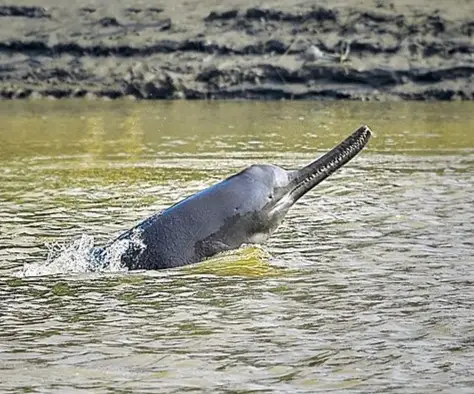
 📸 Photo
Photo: Kukil Gogoi · CC BY-SA 4.0 · Wikimedia Commons Source
Ganges River Dolphin
Platanista gangetica (Ganges River Dolphin · ガンジスカワイルカ)
💡 Everyday Comparisons for Size, Mass & Speed
- 💡 Its snout length of 21 cm is equal to the short side of an A4 sheet of paper (21 cm) (Comparison).
- 💡 Its oil has been used in traditional medicine and its meat as fish bait, but because it is no more effective than ordinary fish scraps, fishers are being encouraged to use substitutes instead.
- 💡 Sitting at the top of the river food web, it is studied as an indicator species for water and environmental quality.
Reference standards: coach bus ~12 m, mid-size car ~4.9 m, compact car ~1 t, basketball hoop 3.05 m, credit card 8.56 cm.
Site-computed relative index from recorded values; not a formal scientific metric.
📖 1. Overview
The Ganges River Dolphin is a freshwater dolphin with a very long snout that lives in the large rivers of South Asia.
🦴 2. Anatomy & Morphology
Its snout is elongated and flat, widest at the tip and curving slightly upward. It grows up to 20% of the body length and reaches 21 cm. Long, sharp teeth line both the upper and lower jaws and remain visible even when the mouth is closed.
🔍 3. Ecology & Behavior
As a top predator in its rivers, it swims on its side and uses its flexible neck to probe the river bottom, startling hidden prey and herding fish and crustaceans. It usually lives alone but sometimes gathers loosely in groups of 3–10.
🇰🇷 4. Connection to Korea
No direct record connecting this species to Korea has been found.
📚 Sources & References
- • IUCN Red List EN (2022) — https://www.iucnredlist.org/species/41756/50383346
- • IUCN Red List category EN — latest assessment at iucnredlist.org
- • mammaldiversity.org — 1006462
- • iucnredlist.org — 50383346
- • wikidata.org — Q210872
- • commons.wikimedia.org — File:Ganges River Dolphin cropped.jpg
- • animaldiversity.org — Platanista gangetica
Recorded dimensions are widely cited representative estimates from public literature and may vary by study or specimen.