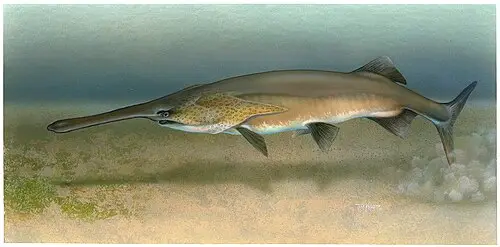
 📸 Photo
Photo: Timothy Knepp · Public domain · Wikimedia Commons Source
Mississippi paddlefish
Polyodon spathula (Mississippi paddlefish · ヘラチョウザメ)
💡 Everyday Comparisons for Size, Mass & Speed
- 💡 Its maximum length of 2.5 m is longer than a bed (about 2 m) (Comparison).
- 💡 Its maximum weight of 70 kg equals 3–4 bags of 20 kg rice (Comparison).
- 💡 Its large, flavorful flesh has long been used as food, and its roe sells for high prices as caviar. When Iranian caviar imports were blocked in the 1980s, poaching for its roe caused a sharp population decline (Animal Diversity Web).
Reference standards: coach bus ~12 m, mid-size car ~4.9 m, compact car ~1 t, basketball hoop 3.05 m, credit card 8.56 cm.
Site-computed relative index from recorded values; not a formal scientific metric.
📖 1. Overview
The Mississippi paddlefish is a large North American freshwater fish with a long, spatula-like snout that filter-feeds on plankton. Closely related to sturgeons, its roe is used as caviar.
🦴 2. Anatomy & Morphology
Its snout (rostrum) extends far forward and uses electroreceptors on its surface to locate zooplankton. It has large gill rakers, a cartilaginous skeleton, and no scales.
🔍 3. Ecology & Behavior
It filter-feeds on zooplankton such as water fleas, copepods, and mayfly nymphs in turbid water. When migrating to spawn, it requires areas with sand or gravel bars. A lifespan of up to 55 years has been reported.
🇰🇷 4. Connection to Korea
No direct record connecting this species to Korea has been found.
📚 Sources & References
- • IUCN Red List VU (2022) — https://www.iucnredlist.org/species/17938/81763841
- • IUCN Red List category VU — latest assessment at iucnredlist.org
- • catalogueoflife.org — 6W65D
- • iucnredlist.org — 81763841
- • wikidata.org — Q827142
- • commons.wikimedia.org — File:Paddlefish Polyodon spathula.jpg
- • animaldiversity.org — Polyodon spathula
- • fishbase.se — Polyodon-spathula.html
- • Silhouette: PhyloPic — author not recorded · CC0 1.0
Recorded dimensions are widely cited representative estimates from public literature and may vary by study or specimen.