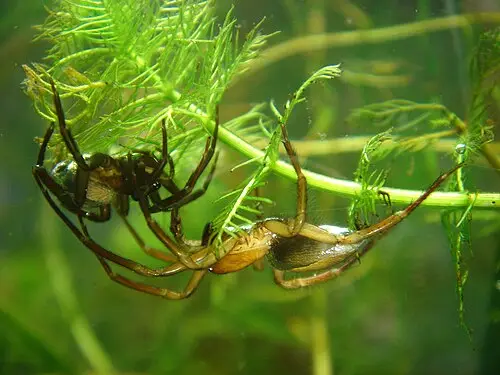
 📸 Photo
Photo: Norbert Schuller Baupi · CC BY-SA 3.0 · Wikimedia Commons Source
Diving bell spider
Argyroneta aquatica (Diving bell spider · ミズグモ)
🇰🇷 Class II endangered wildlife (Korea)
💡 Everyday Comparisons for Size, Mass & Speed
- 💡 Its maximum body length of 15 mm is about 3/5 the diameter of a 100-won coin (24 mm).
- 💡 Its appearance when diving underwater wrapped in an air bubble around its abdomen brings to mind a scuba diver diving with an air tank.
- 💡 The National Institute of Ecology noted that weather changes frequently heard on the news, such as torrential rains and severe droughts, directly threaten this spider's wetland habitat.
Reference standards: coach bus ~12 m, mid-size car ~4.9 m, compact car ~1 t, basketball hoop 3.05 m, credit card 8.56 cm.
📖 1. Overview
The diving bell spider (Argyroneta aquatica) is the only spider that spends its entire life underwater, building a bell-shaped air web among aquatic plants. In Korea, it is a Class II Endangered Wildlife species found only in Yeoncheon County, Gyeonggi Province, and is listed by the IUCN as Near Threatened (NT, published in 2026).
🦴 2. Anatomy & Morphology
Body length is 9 to 12 mm in males and 8 to 15 mm in females, with 8 simple eyes arranged in two rows. Dense short hairs covering the abdomen allow it to trap an air bubble against its body.
🔍 3. Ecology & Behavior
It breathes through the air bubble enveloping its abdomen, and when oxygen runs low, it rises to the surface to replenish the air before diving again. It feeds on aquatic insects and nematodes, and mates and lays eggs inside its air bell around June to July.
🇰🇷 4. Connection to Korea
In Korea, it is found only in Yeoncheon County, Gyeonggi Province, and is designated as a Class II Endangered Wildlife species. Changes in rainfall timing, torrential downpours, severe droughts, and plants that turn wetlands into dry land are its main threats.
📚 Sources & References
- • IUCN Red List NT (2026) — https://www.iucnredlist.org/species/85737177/213955433
- • 멸종위기 야생생물 Ⅱ급 — 국가생물종목록(국립생물자원관) ktsn 120000044958 — https://species.nibr.go.kr/home/mainHome.do?cont_link=009&subMenu=009002&contCd=009002&ktsn=120000044958
- • IUCN Red List category NT — latest assessment at iucnredlist.org
- • Korean protection status: Class II endangered wildlife (Korea)
- • catalogueoflife.org — GK6Y
- • iucnredlist.org — 213955433
- • 국가생물종목록(국립생물자원관) ktsn 120000044958 — https://species.nibr.go.kr/home/mainHome.do?cont_link=009&subMenu=009002&contCd=009002&ktsn=120000044958
- • wikidata.org — Q119195
- • commons.wikimedia.org — File:Argyroneta aquatica Paar.jpg
- • nie.re.kr — view.do
Recorded dimensions are widely cited representative estimates from public literature and may vary by study or specimen.