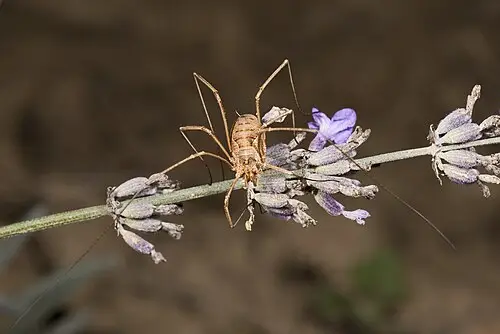
 📸 Photo
Photo: Didier Descouens · CC BY-SA 4.0 · Wikimedia Commons Source
Common harvestman
Phalangium opilio (Common harvestman · Common harvestman)
Not Evaluated (NE) on the IUCN Red List yet.
💡 Everyday Comparisons for Size, Mass & Speed
- 💡 A maximum body length of 9 mm is close to the length of two grains of rice (about 5 mm each) laid end to end (Comparison).
- 💡 Common in fields of food crops such as corn, potatoes, cabbages, strawberries, and apples, it is part of the predator guild that preys on pests like aphids.
Reference standards: coach bus ~12 m, mid-size car ~4.9 m, compact car ~1 t, basketball hoop 3.05 m, credit card 8.56 cm.
📖 1. Overview
The common harvestman is an arachnid in the order Opiliones that resembles a spider but is not one, and is the most common species on human-disturbed land in temperate regions. It has a short, round body and long, slender legs.
🦴 2. Anatomy & Morphology
Adult body length is 3.5–9 mm, with males generally smaller than females. Like spiders, it has eight legs and no antennae, and the upper side of the body has dull gray or brown markings.
🔍 3. Ecology & Behavior
In crop fields it eats soft-bodied animals such as aphids, caterpillars, leafhoppers, mites, and small slugs, as well as dead insects, decaying matter, and earthworms. In Europe it has 1 generation per 1 year and overwinters as an egg.
🇰🇷 4. Connection to Korea
No direct record connecting this species to Korea has been found.
📚 Sources & References
- • IUCN Red List: not evaluated (NE) — cross-checked with the Wikidata conservation-status entry
- • catalogueoflife.org — 7WCJP
- • wikidata.org — Q21059
- • commons.wikimedia.org — File:Phalangium opilio MHNT Face.jpg
- • biocontrol.entomology.cornell.edu — Phalangium.php
- • Silhouette: PhyloPic — author not recorded · CC0 1.0
Recorded dimensions are widely cited representative estimates from public literature and may vary by study or specimen.