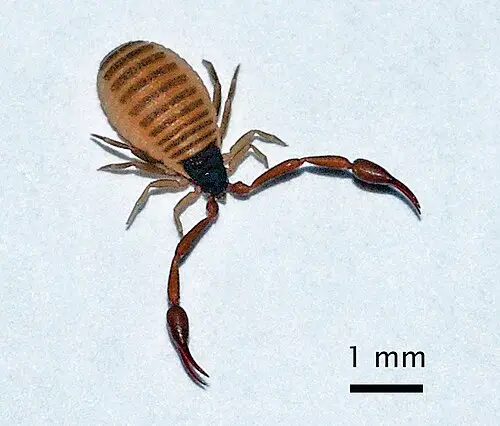
 📸 Photo
Photo: Christian Fischer · CC BY-SA 3.0 · Wikimedia Commons Source
House pseudoscorpion
Chelifer cancroides (House pseudoscorpion · House pseudoscorpion)
Not Evaluated (NE) on the IUCN Red List yet.
💡 Everyday Comparisons for Size, Mass & Speed
- 💡 Its body length of 4 mm is shorter than a grain of rice (about 5 mm) (Comparison). Its 8 mm span with pincers spread is about one and a half grains of rice.
- 💡 Materials from Colorado State University state that this is the pseudoscorpion most frequently found indoors and explain that this group catches small pests such as mites and springtails. Specimens of this species are also held at the Grant Museum of Zoology at University College London (UCL).
Reference standards: coach bus ~12 m, mid-size car ~4.9 m, compact car ~1 t, basketball hoop 3.05 m, credit card 8.56 cm.
📖 1. Overview
The house pseudoscorpion is the pseudoscorpion most commonly found inside buildings; it has scorpion-like pincers but lacks a tail and venomous stinger.
🦴 2. Anatomy & Morphology
Its mahogany-brown body is 3–4 mm long, and with its long pincer-bearing pedipalps spread out, it spans about 8 mm across.
🔍 3. Ecology & Behavior
Pseudoscorpions usually wait in crevices for mites, springtails, and small insects, seize them with their pincers, immobilize them with venom, and liquefy them with digestive fluid to drink. In this species, the young ride on the mother's back for a while before molting and leaving.
🇰🇷 4. Connection to Korea
No direct record connecting this species to Korea has been found.
📚 Sources & References
- • IUCN Red List: not evaluated (NE) — cross-checked with the Wikidata conservation-status entry
- • catalogueoflife.org — 5XQX9
- • wikidata.org — Q937723
- • commons.wikimedia.org — File:CheliferCancroides1.jpg
- • webdoc.agsci.colostate.edu — Pseudoscorpions.pdf
- • blogs.ucl.ac.uk — specimen-of-the-week-week-ninety-four
- • Silhouette: PhyloPic — Gareth Monger · CC BY 3.0
Recorded dimensions are widely cited representative estimates from public literature and may vary by study or specimen.