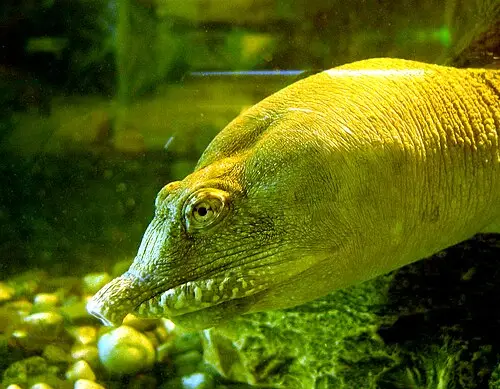
 📸 Photo
Photo: Bastet78 · CC BY-SA 3.0 · Wikimedia Commons Source
Chinese Soft-shelled Turtle
Pelodiscus sinensis (Chinese Soft-shelled Turtle · スッポン)
💡 Everyday Comparisons for Size, Mass & Speed
- 💡 A maximum carapace length of 30 cm is the same size as the long side of an A4 sheet of paper (about 30 cm) (Comparison).
- 💡 Juveniles imported and released under the belief that they were native softshell turtles have spread so widely that they can now be seen in rivers and reservoirs nationwide (National List of Species of Korea).
Reference standards: coach bus ~12 m, mid-size car ~4.9 m, compact car ~1 t, basketball hoop 3.05 m, credit card 8.56 cm.
📖 1. Overview
The Chinese Soft-shelled Turtle is a softshell turtle native to China that has also spread widely in rivers and reservoirs across Korea. Its IUCN assessment is Vulnerable (VU) as of 2000.
🦴 2. Anatomy & Morphology
Its carapace ranges from olive to bluish gray, is covered with soft leathery skin, and has many small tubercles. It can withdraw its head and neck completely into its shell, and its nose is shaped like an elongated tube that it pokes above the water surface to breathe.
🔍 3. Ecology & Behavior
It lives alone, is active mainly during the day, and is carnivorous, preying on freshwater mollusks, crustaceans, insects, fish, and amphibians. In months 5–7 it digs holes in waterside soil to lay eggs, and from month 11 to month 3 it hibernates.
🇰🇷 4. Connection to Korea
Its domestic distribution is listed as 'nationwide' in the National List of Species of Korea, living in rivers and reservoirs across the country. Because it was regarded as the same species as the Amur Softshell Turtle, juveniles imported from Southeast Asia and southern China and released into the wild spread through rivers nationwide.
📚 Sources & References
- • IUCN Red List VU (2000) — https://www.iucnredlist.org/species/39620/97401140
- • IUCN Red List category VU — latest assessment at iucnredlist.org
- • catalogueoflife.org — 76CTF
- • iucnredlist.org — 97401140
- • 국가생물종목록(국립생물자원관) ktsn 120000059460 — https://species.nibr.go.kr/home/mainHome.do?cont_link=009&subMenu=009002&contCd=009002&ktsn=120000059460
- • wikidata.org — Q754028
- • commons.wikimedia.org — File:8 pazdziernika 2005 gliwice 062.jpg
- • species.nibr.go.kr — mainHome.do
- • Silhouette: PhyloPic — Soledad Miranda-Rottmann · CC BY 3.0
Recorded dimensions are widely cited representative estimates from public literature and may vary by study or specimen.