 📸 Photo
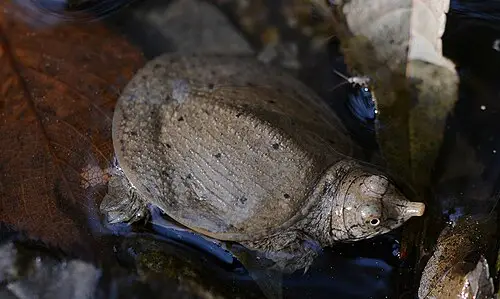
Photo: Kim, Hyun-tae · CC BY 4.0 · Wikimedia Commons Source
Amur Softshell Turtle
Pelodiscus maackii (Amur Softshell Turtle · Amur Softshell Turtle)
Not Evaluated (NE) on the IUCN Red List yet.
💡 Everyday Comparisons for Size, Mass & Speed
- 💡 A carapace of 35 cm is longer than the long side of an A4 sheet of paper (29.7 cm) (Comparison).
- 💡 Based on fishermen's observations, the Ussuri River research team considered females mature from about 900 g and males from about 800 g. A weight of 900 g is about the weight of 15 chicken eggs (Comparison).
Reference standards: coach bus ~12 m, mid-size car ~4.9 m, compact car ~1 t, basketball hoop 3.05 m, credit card 8.56 cm.
📖 1. Overview
The Amur Softshell Turtle is a softshell turtle living in freshwaters of the Russian Far East, northeastern China, the Korean Peninsula, and Japan, and its carapace is not hard.
🦴 2. Anatomy & Morphology
The carapace of adults is olive brown to dark brown and can exceed 35 cm in length.
🔍 3. Ecology & Behavior
Korean amphibian and reptile references group softshell turtles as waterside turtles that eat bivalves, crustaceans, and plants. In a study on the Ussuri River in China, juvenile Amur Softshell Turtles stayed in backwater channels and along banks with aquatic plants and submerged wood.
🇰🇷 4. Connection to Korea
Morphological and genetic studies have confirmed that it also lives in rivers of Korea and Japan, and in Korea it inhabits large watersides and lowlands. A table in one study lists it as Vulnerable (VU) on the National Red List of Korea.
📚 Sources & References
- • IUCN Red List: not evaluated (NE) — cross-checked with the Wikidata conservation-status entry
- • catalogueoflife.org — 76CTC
- • 국가생물종목록(국립생물자원관) ktsn 120000059459 — https://species.nibr.go.kr/home/mainHome.do?cont_link=009&subMenu=009002&contCd=009002&ktsn=120000059459
- • wikidata.org — Q3007906
- • commons.wikimedia.org — File:Pelodiscus maackii 55532827 (cropped).jpg
- • pmc.ncbi.nlm.nih.gov — PMC6382751
- • pmc.ncbi.nlm.nih.gov — PMC11758296
- • pmc.ncbi.nlm.nih.gov — PMC11010935
- • pmc.ncbi.nlm.nih.gov — PMC9816106
- • pmc.ncbi.nlm.nih.gov — PMC9436999
- • reptile-database.reptarium.cz — species
- • species.nibr.go.kr — general-search
- • Silhouette: PhyloPic — Soledad Miranda-Rottmann · CC BY 3.0 (Congeneric silhouette — Pelodiscus sinensis)
Recorded dimensions are widely cited representative estimates from public literature and may vary by study or specimen.