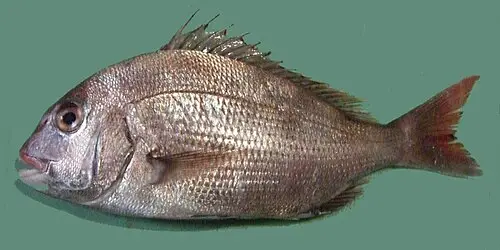
 📸 Photo
Photo: Miya · CC BY-SA 3.0 · Wikimedia Commons Source
Red seabream
Pagrus major (Red seabream · マダイ)
💡 Everyday Comparisons for Size, Mass & Speed
- 💡 Its maximum weight of 9.7 kg is about the weight of one 10 kg bag of rice (Comparison).
- 💡 It is a high-grade food fish used in a wide variety of dishes including raw fish, grilled, braised, dried, steamed, and stewed preparations (National List of Species of Korea).
- 💡 In Japan, it fetches a high price and is served on celebratory occasions such as weddings and festivals (FishBase).
Reference standards: coach bus ~12 m, mid-size car ~4.9 m, compact car ~1 t, basketball hoop 3.05 m, credit card 8.56 cm.
Site-computed relative index from recorded values; not a formal scientific metric.
📖 1. Overview
The red seabream is a red-bodied seabream living on coastal bottoms from south of Hokkaido, Japan, to the South China Sea. The IUCN (2014) assessed it as Least Concern (LC).
🦴 2. Anatomy & Morphology
Its body is reddish-brown with a silvery-white belly and glossy blue spots scattered across the upper half. Because body coloration varies greatly by habitat, it is difficult to tell wild and farmed fish apart.
🔍 3. Ecology & Behavior
It feeds on crustaceans, fish, polychaete worms, and echinoderms. Juveniles stay in shallow coastal waters and move to depths of 30–200 m after growing for 2–3 years, spawning in May–July.
🇰🇷 4. Connection to Korea
According to the National List of Species of Korea, it lives in all sea areas around Korea, is caught from spring to autumn, and is also widely farmed.
📚 Sources & References
- • IUCN Red List LC (2014) — https://www.iucnredlist.org/species/170167/1286175
- • IUCN Red List category LC — latest assessment at iucnredlist.org
- • catalogueoflife.org — 4BZNP
- • iucnredlist.org — 1286175
- • 국가생물종목록(국립생물자원관) ktsn 120000058602 — https://species.nibr.go.kr/home/mainHome.do?cont_link=009&subMenu=009002&contCd=009002&ktsn=120000058602
- • wikidata.org — Q1196387
- • commons.wikimedia.org — File:Pagrus major Red seabream ja01.jpg
- • fishbase.se — Pagrus-major.html
- • species.nibr.go.kr — mainHome.do
- • Silhouette: PhyloPic — Chris Forbes · CC BY 4.0 (Related taxon silhouette — Boops boops)
Recorded dimensions are widely cited representative estimates from public literature and may vary by study or specimen.