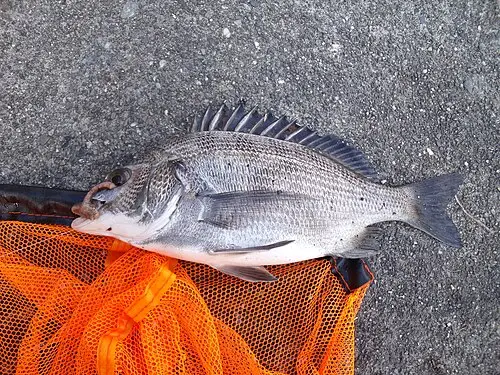
 📸 Photo
Photo: TMDSA · CC BY-SA 3.0 · Wikimedia Commons Source
Blackhead seabream
Acanthopagrus schlegelii (Blackhead seabream · Blackhead seabream)
💡 Everyday Comparisons for Size, Mass & Speed
- 💡 A maximum weight of 3.2 kg is a little over two 1.5 L PET bottles (comparison).
- 💡 It is targeted by commercial fisheries, aquaculture, and recreational anglers (FishBase).
- 💡 A single individual undergoes an unusual growth process in which it changes sex from male to female as it matures (Korea's National Species List).
Reference standards: coach bus ~12 m, mid-size car ~4.9 m, compact car ~1 t, basketball hoop 3.05 m, credit card 8.56 cm.
Site-computed relative index from recorded values; not a formal scientific metric.
📖 1. Overview
The blackhead seabream is a porgy living in bays, shallow rocky zones, and river estuaries, distributed from south of Hokkaido, Japan to Taiwan. The IUCN (2014) assessed it as Least Concern (LC).
🦴 2. Anatomy & Morphology
The body is oval and laterally compressed with a slightly protruding snout, and its vision, smell, and hearing are well developed. Faint dark gray crossbars run over a silvery-blue ground color.
🔍 3. Ecology & Behavior
Juveniles live in bays and rocky coasts, feeding on invertebrates such as crustaceans, mollusks, and polychaetes. One-year-olds are mostly male, 2–3-year-olds are hermaphroditic, and once fully grown most change sex into females; the spawning season is March–July.
🇰🇷 4. Connection to Korea
According to Korea's National Species List, it occurs throughout all marine waters of Korea.
📚 Sources & References
- • IUCN Red List LC (2014) — https://www.iucnredlist.org/species/170153/20567110
- • IUCN Red List category LC — latest assessment at iucnredlist.org
- • catalogueoflife.org — 8YVQ
- • iucnredlist.org — 20567110
- • 국가생물종목록(국립생물자원관) ktsn 120000058593 — https://species.nibr.go.kr/home/mainHome.do?cont_link=009&subMenu=009002&contCd=009002&ktsn=120000058593
- • wikidata.org — Q10398535
- • commons.wikimedia.org — File:Acanthopagrus schlegelii.JPG
- • fishbase.se — Acanthopagrus-schlegelii.html
- • species.nibr.go.kr — mainHome.do
- • Silhouette: PhyloPic — Chris Forbes · CC BY 4.0 (Related taxon silhouette — Boops boops)
Recorded dimensions are widely cited representative estimates from public literature and may vary by study or specimen.